A hook in writing is the opening line, frame, or visual that earns the next 7 seconds of attention. On TikTok and Instagram Reels, put the promise first, then deliver it quickly, because a hook is judged by whether people keep watching, reading, or scrolling.
You know the moment. You've made the tutorial, polished the caption, added the captions, and chosen a cover image. Then the post opens with “Hey everyone, today I'm going to show you…” while the viewer has already moved on. The topic wasn't necessarily weak. The entry point was.
A good hook names a tension, creates a question, or promises a useful result before attention disappears. It works in a blog introduction, a TikTok script, an Instagram caption, a LinkedIn post, a Threads update, and a long-form essay. The container changes, but the job stays the same: make the next line feel worth consuming.
What a Hook Actually Does in Writing
A hook in writing is a deliberate opening that buys continued attention. For a blog visitor, it may be the first sentence. For a Reel, it may combine spoken words, on-screen text, and a visual action. For a podcast, it could be the first question or story beat.
The hook doesn't need to be loud. It needs to be relevant fast.
Consider two creators explaining the same content-planning problem. One starts with, “Content calendars are useful for organizing your posts.” The other begins, “You don't need more ideas. You need a way to stop abandoning them after Monday.” The second opening identifies a specific frustration, creates recognition, and implies that the post will offer a solution. The first gives background that the audience already understands.
A headline and a hook overlap, but they aren't interchangeable.
- The headline earns the click. It tells someone what the piece is about and why it might matter.
- The hook earns the continuation. It convinces the person who clicked, stopped, or landed on the post to give you more attention.
- The promise connects them. The headline sets an expectation, and the hook makes that expectation feel immediate.
Practical rule: Treat the opening as a contract. Promise a specific payoff, then make the body pay it off.
This is why a hook shouldn't be a random shock line pasted onto an unrelated post. “You're making this mistake” creates tension only if the body identifies the mistake and helps the audience fix it. Curiosity without satisfaction becomes bait-and-switch, and bait-and-switch damages trust even when it earns an initial view.
Strong openings usually combine three ingredients: a pattern interrupt, a clear value promise, and immediate relevance. Independent writing guidance also describes a roughly 7-second decision window for readers deciding whether to continue, which makes conflict, character, and concrete detail more useful than exposition-heavy starts (guidance on first-paragraph hooks).
The practical consequence is simple. Don't begin with everything the audience needs to know. Begin with the one thing that makes them want to know the rest.
The Psychology Behind a Strong Hook
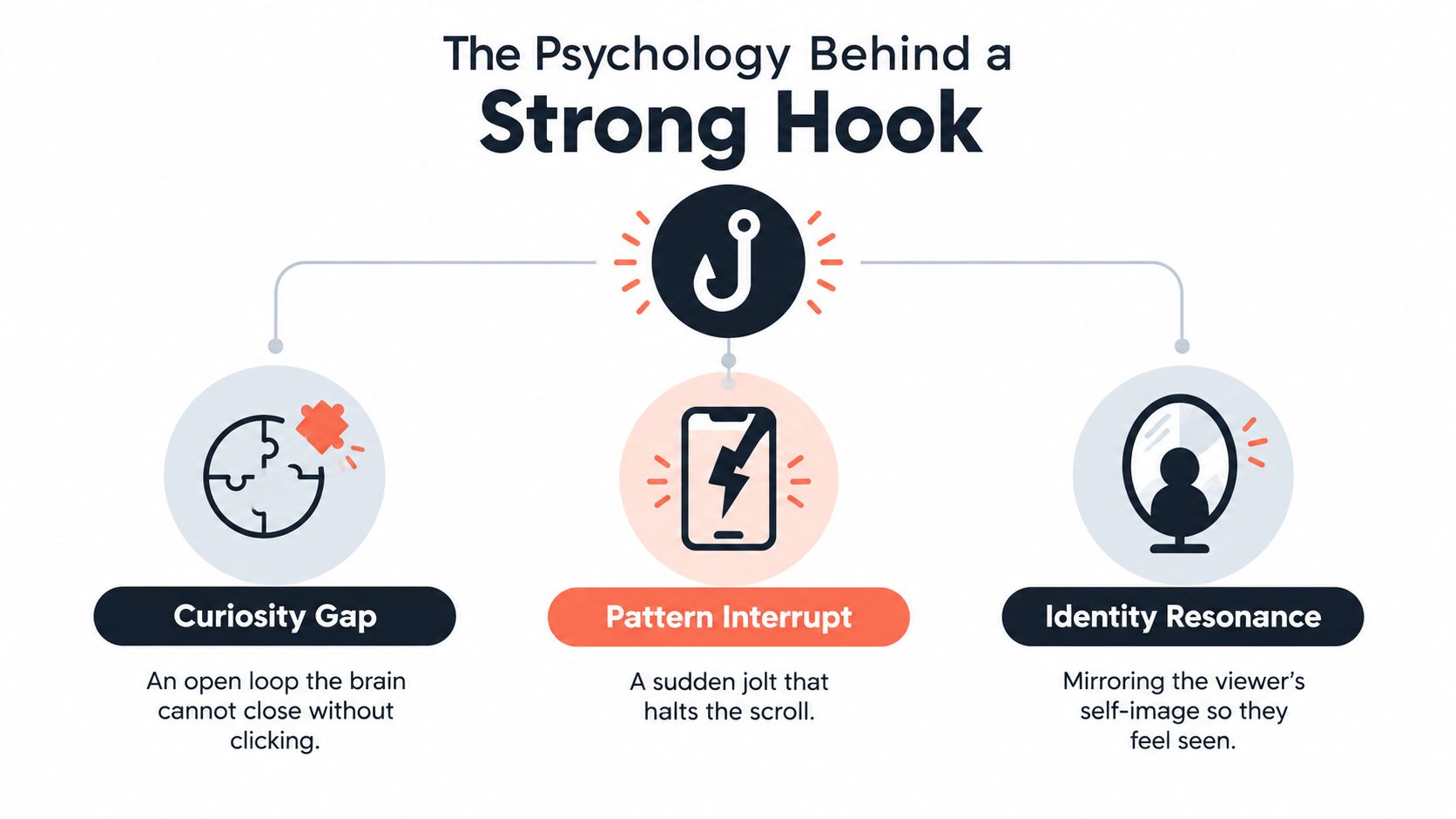
A strong hook usually activates at least one of three reactions: curiosity gap, pattern interrupt, or identity resonance. The best openings often combine two, then use the body to deliver the promised answer.
Curiosity gap
A curiosity gap opens a loop without making the audience feel manipulated. It presents an incomplete problem, surprising detail, or promised explanation that the next line can close.
Weak: “Here are some Instagram tips.”
Stronger: “Your best Reel idea may be losing reach before the first sentence finishes.”
The stronger version creates questions. What is causing the loss? What does “first sentence” mean in a video? Is the problem the idea, the editing, or the hook? The audience continues because the opening gives them a reason to resolve the uncertainty.
Curiosity needs a destination. If the post only keeps teasing, the audience learns that your openings aren't reliable. A useful curiosity hook creates an open loop, then closes it with an actionable explanation.
Pattern interrupt
Feeds train people to expect familiar rhythms: greeting, topic introduction, broad promise, demonstration. A pattern interrupt breaks that rhythm with an unexpected phrase, visual, sound, or movement.
Weak: “In today's video, I'll share three ways to improve your content.”
Stronger: “Delete your first sentence.”
The second line creates a jolt. It also needs context immediately afterward, such as, “If your caption begins with background, your useful point may be hidden below the fold.” The interrupt earns attention, while the explanation earns trust.
A visual can do the same work. Start with the finished result, cut directly to the mistake, or place the creator in the middle of an action instead of showing a talking-head introduction. Screen-based attention is often measured in tens of seconds rather than minutes, so guidance for blog hooks recommends front-loading the payoff and using specific sensory or factual language (attention and blog hook guidance).
Identity resonance
Identity resonance tells someone, “This was made for a person like you.” It can name a role, goal, situation, location, or frustration.
Generic: “Creators need a content strategy.”
Identity-led: “If you run a small business and create posts after closing time, your content plan needs fewer ideas and clearer decisions.”
The second line reflects a lived situation. A small-business owner, part-time creator, or social media manager can recognize themselves without needing a dramatic claim.
Use identity carefully. Don't invent a tribe just to force relevance. Name the audience's real context, then connect it to a useful outcome. A hook becomes more persuasive when the viewer feels understood and can picture the result.
You can explore how visual choices reinforce these psychological signals in visual storytelling techniques. The wording may stop the scroll, but the frame, text overlay, and first movement must support the same promise.
Hook Types You Can Reuse on Demand
A creator staring at a blank caption can choose a hook by job, not by mood. Each type creates a different reason to continue, then gives you a line you can adapt for a TikTok or Reel.
| Hook Type | Psychological Trigger | One-Line Template |
| Bold claim | Pattern interrupt | “You don't need X to achieve Y. You need Z.” |
| Question | Curiosity gap | “Why does X keep happening when you're already doing Y?” |
| Stat shock | Surprise and credibility | “Only [relevant sourced figure] separates the common approach from the overlooked one.” |
| Story open | Identity and narrative tension | “Three months ago, I was Y. Today, I'm Z. Here's the bridge.” |
| Confession | Vulnerability and trust | “I gave up X because it was quietly causing Y.” |
| How-to promise | Clear value | “Here's how to turn X into Y without Z.” |
| Contrast | Conflict | “Creators focused on X often miss Y. The ones solving Y do Z.” |
| Contrarian take | Pattern interrupt | “Most creators assume X. Here's why the assumption fails.” |
A bold claim earns attention when the audience recognizes the problem and the post can support the promise. Say, “Stop adding more content pillars,” then show how a narrower plan helps a creator decide what to publish. The line creates tension, while the explanation pays it off.
A question should expose a real concern, not merely include a keyword. “Why are my Reels getting watched but not saved?” opens an investigation with a clear outcome. “Do you want better content?” invites an obvious yes and gives viewers no reason to stay.
A statistic hook can add credibility when the number is relevant, sourced, and explained. The 2026 Frontiers in Communication study on text-based hooks found that only a small subset of hook signals retained predictive value after statistical adjustment, while engagement was dominated by exposure. Treat that as a testing warning: wording matters, but reach also depends on who sees the post and how often it is exposed.
Story, confession, and contrast hooks suit personal brands because each creates movement. A story takes the viewer from a defined before to a defined after. A confession lowers the polished surface and introduces a cost or mistake. Contrast puts two approaches side by side, giving the audience a decision to evaluate.
For platform-native examples, the starryai viral content playbook shows how attention mechanics can become creative formats. Adapt the structure to your subject, then shoot the first action or caption line so it delivers the same promise as the opening.
Matching Your Hook to the Right Platform
A hook isn't portable by default. The same line can work as spoken dialogue on TikTok, fail as Instagram caption text, and feel perfectly natural as the opening sentence of a blog post.
| Platform | Reader's Time Budget | Winning Hook Shape | Watch the For |
| TikTok | Immediate feed decision | Spoken first line plus visual action | Deliver the promise before the setup |
| Instagram Reels | Fast mobile viewing | On-screen text, movement, and concise spoken hook | Make the idea clear with sound off |
| Instagram caption | Skim before expanding | Strong first visible lines, followed by context | Put the tension before the “more” break |
| X or Threads | Rapid text scanning | Specific claim, observation, or question | Make the first sentence self-contained |
| Blog or essay | Intentional reading decision | Opening sentence with tension, detail, or payoff | Connect the promise to the reader's problem |
TikTok and Reels need a hook that survives motion, sound-off viewing, and rapid swiping. A spoken line such as “Your content calendar isn't too small. It's too hard to use” becomes stronger when the creator shows a crowded calendar, then replaces it with a focused plan.
Instagram captions need the first visible lines to work before the reader expands the text. Start with the result, mistake, or emotional tension. Don't spend the opening thanking people, describing your morning, or repeating the post's title.
X and Threads reward compact ideas that stand on their own. “The best content idea is the one your audience already asks you to explain” can lead into a short argument. It doesn't need the visual escalation of a Reel.
A blog or essay has more room, but that doesn't excuse a slow start. Open with the reader's tension, a concrete scene, or a specific contradiction. A long-form introduction can develop nuance after it has earned the first paragraph.
Platform-native execution matters because format shapes expectation. This comparison of TikTok or Instagram can help you decide whether the same idea should become a video script, carousel, caption, or text post.
Ready-to-Use Hook Templates for TikTok and Reels
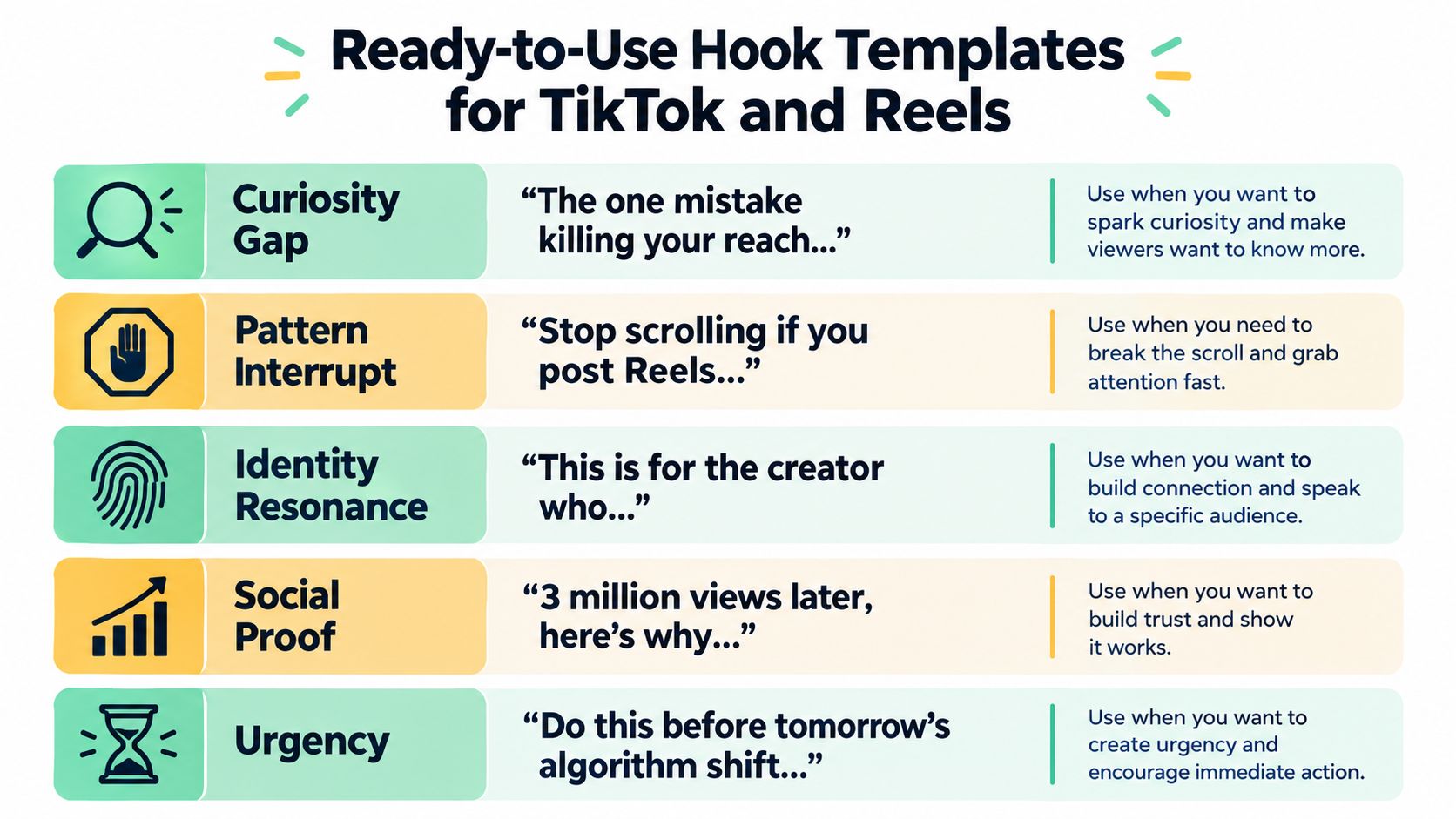
The fastest way to improve a Reel is to stop writing the hook as an afterthought. Write the opening before you script the middle, then make every scene support the promise.
Curiosity gap
Template: “The one thing nobody tells you about [topic] is [unfinished insight].”
Example: “The one thing nobody tells you about planning Reels is that your idea can be clear and still be impossible to film.”
Why it works: It identifies a hidden complication and promises an explanation.
Editing lever: Put the unfinished insight in large on-screen text, then cut to the specific planning mistake before explaining it.
Bold claim
Template: “Stop doing [common mistake] in the first few seconds.”
Example: “Stop introducing yourself before you tell viewers why they should stay.”
Why it works: The line challenges a familiar behavior and creates immediate tension.
Editing lever: Open on the mistake itself. Show the slow introduction, cut it off, and replace it with the direct promise.
Pattern interrupt
Template: “Wait, before you scroll, [specific action].”
Example: “Wait, before you scroll, read the first line of your last caption out loud.”
Why it works: The interruption feels immediate, while the action creates participation.
Editing lever: Use a sudden camera movement, hand gesture, or visual change, but keep the words tied to the lesson.
Specific number
Use numbers only when they are real and relevant. A 2025 study on creative hooks in short-form video promotion reported stronger outcomes across multiple engagement indicators for videos using creative hooks than for traditional videos (study on creative hooks). A separate 2026 benchmark cited by Donivo found question hooks averaged 2.2% engagement, while problem-first hooks averaged 4.3% among 648 small-business social posts (Donivo benchmark summary). Those figures describe specific samples, not a universal guarantee.
Template: “I tested [verified number] versions of [asset]. These [number] patterns kept winning.”
Example: “I tested five opening lines for the same tutorial. These three made the promise clearest.”
Why it works: A precise number suggests a process, but the credibility comes from showing the method and limits.
Editing lever: Display the versions as quick cards, then reveal the selected line with the reason it earned the cut.
Relatable moment
Template: “POV: you're a [role] on [specific situation].”
Example: “POV: you're a small-business owner writing tomorrow's Reel after closing time.”
Why it works: It mirrors a recognizable experience and makes the viewer feel addressed.
Editing lever: Show the physical details of the situation, such as the late desk, unfinished notes, or crowded phone screen.
Direct call-out
Template: “If you [audience condition] and [problem], this is for you.”
Example: “If you sell a product and your views are flat, start by replacing the first sentence.”
Why it works: It filters for relevance and makes the payoff easy to understand.
Editing lever: Repeat the audience condition in the caption so the spoken line and written context reinforce each other.
For more ready-to-shoot examples, browse top TikTok hook ideas for 2026. You can also compare these patterns with a guide to best video hook strategies, especially when adapting a hook for paid or promotional creative.
Start the video with a line the viewer can understand without context. Then show the proof, process, or transformation promised by that line.
Instagram Reels can run up to 3 minutes, while some guidance also describes longer in-app recordings up to 20 minutes. Creator guidance commonly favors shorter versions for discovery, including clips under 90 seconds or under 3 minutes, depending on the objective (Instagram Reels length guidance). The practical lesson is not to stretch a hook across a long introduction. Match the opening to the message, then use the shortest format that can deliver it.
Instagram recommends a vertical aspect ratio between 1.9:1 and 9:16, a minimum frame rate of 30 fps, and minimum resolution of 720 pixels for Reels (Instagram Reels format requirements). Technical quality won't rescue a vague hook, but a clear visual frame and readable text make the promise easier to grasp.
Hook Mistakes That Quietly Kill Reach
Most weak hooks don't fail dramatically. They fail by delaying the moment when the viewer understands why the post matters.
- Throat-clearing intros: “In today's video” describes the container instead of the payoff.
- Brand-first openings: Leading with a company or product name gives the audience no immediate reason to care.
- Vague questions: “Do you want better content?” asks for agreement without naming a problem.
- Unkeepable promises: “This will change everything” creates an expectation the body can't satisfy.
- Delayed hooks: A useful line buried after the opening loses the moment when attention was available.
The central trap is bait-and-switch. A creator promises a shortcut, transformation, or secret, then spends the video discussing something adjacent. The opening may earn a view, but the mismatch weakens watch-through, saves, shares, and trust.
Trends create another quiet problem. A generic sound, caption, or format can make a post look current while making the idea interchangeable. Trend discovery should support a distinct point of view, not replace one.
If your posts feel invisible, diagnose the opening before rebuilding the whole account. The troubleshooting guide on why your TikTok isn't getting views offers a wider performance checklist, but hook diagnosis starts with one question: does the first line make the intended viewer recognize a problem or desired result?
A credible hook doesn't need to promise the biggest outcome. It needs to promise the outcome the body can deliver.
Testing Hooks Without Losing Your Mind
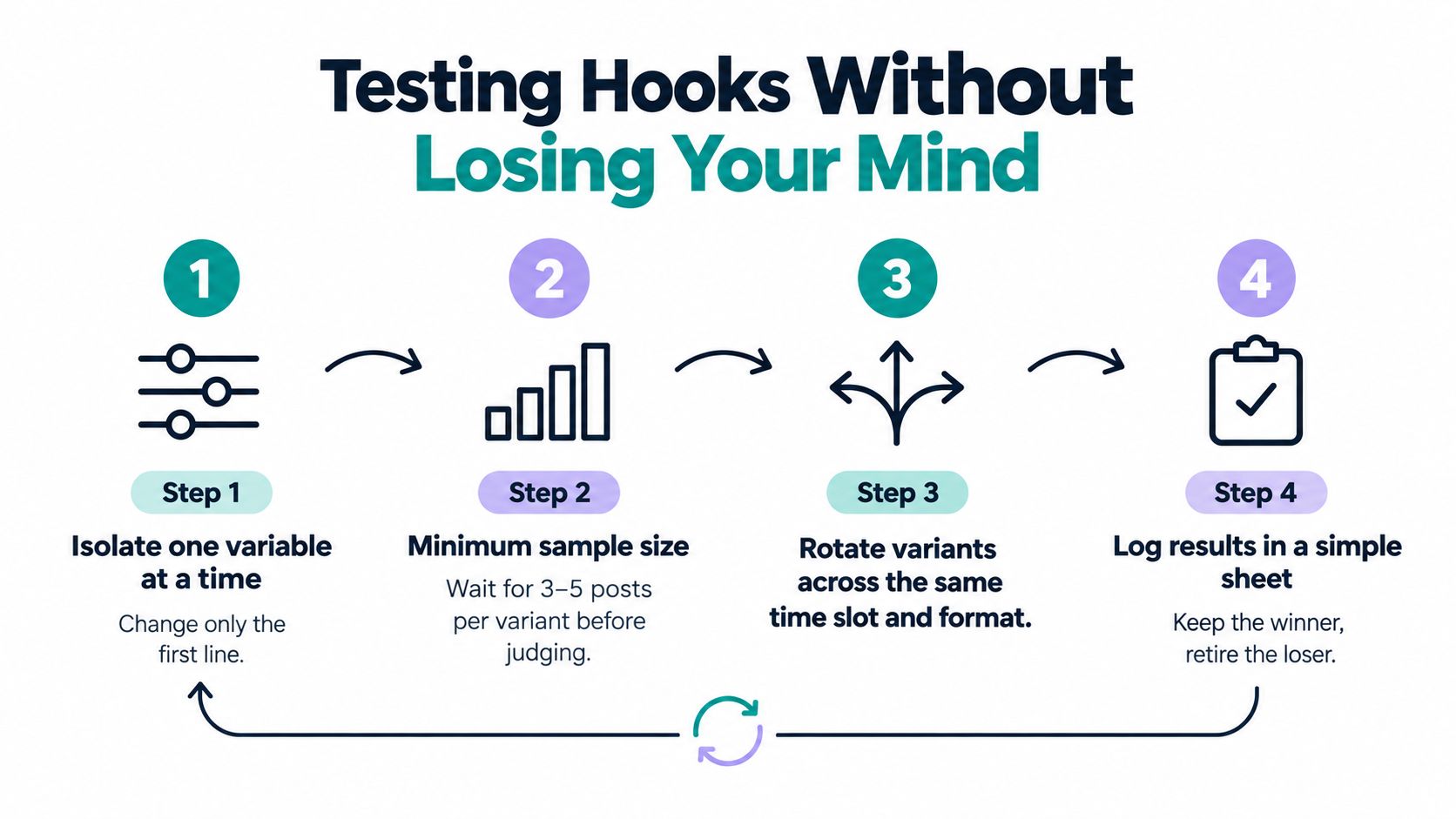
Hook testing becomes manageable when you isolate the variable. Keep the topic, format, audience, and general delivery consistent, then change the first line or first visual. If you change everything at once, you won't know what caused the difference.
Use a small testing log
Create one row for each version:
- Hook variant: Record the exact opening line and visual.
- Hypothesis: State what you expect the variant to improve, such as clarity, relevance, or curiosity.
- Metric: Choose the measure that matches the format.
- Result: Record what happened without rewriting the story afterward.
- Next action: Keep, revise, or retire the opening.
TikTok testing can focus on early viewing behavior. Reels testing can examine saves, shares, and completion patterns. Blog testing can look at dwell time and whether readers continue beyond the introduction. The 2026 Frontiers study is a useful reminder that exposure distribution can dominate engagement, so don't interpret an individual result as proof that wording alone caused it (Frontiers in Communication hook study).
Test the promise, not just the punctuation. A different opening angle can reveal more than a different adjective.
Give each variant enough comparable examples to reveal a pattern. The required comparison depends on your publishing cadence, audience size, and consistency, so avoid declaring a universal winner from one post. Rotate variants across similar formats and time windows, then keep a swipe file of openings that earned meaningful continuation.
This process belongs inside the wider creator workflow:
- Profile Audit: Check whether your bio, offer, and recent posts make the intended audience clear.
- Trends and Ideas: Find relevant formats, sounds, hashtags, questions, and recurring audience problems.
- Content Creation: Turn the selected hook into a ready-to-shoot video script, scene structure, carousel, visual post concept, LinkedIn post, or Threads/X post.
- Performance Analysis: Review retention, engagement, saves, shares, and the next action the audience took.
A cross-format social media co-pilot such as Trendy can connect those decisions by analyzing an account, surfacing personalized ideas and hooks, shaping drafts, and reviewing performance across TikTok, Instagram, Threads, and X. The social media dashboard guide explains how to organize those signals without treating every post as an isolated event.
Turn your next content idea into three opening variants, then use Trendy to develop the winning direction into ready-to-shoot scripts, captions, carousels, or visual post concepts. Visit Trendy, or try the iOS app and Android app to audit your profile, find relevant ideas, and make hook testing part of your publishing workflow.