SEO Title: AI Used in Social Media in 2026: How Creators Turn Ideas Into Posts Faster
Meta Description: Learn how AI is used in social media in 2026, from Reels ideas and scripts to personalization, moderation, ads, and creator workflows.
It's 10 p.m. You still need tomorrow's Reel, a caption for Instagram, a TikTok angle that doesn't feel stale, and some clue about whether any of it will land. That's where AI used in social media starts to feel less like a shiny extra and more like a working part of the job.
Today, AI can help creators brainstorm hooks, draft ready-to-shoot video scripts, reshape one idea into a carousel and a Threads post, spot trends earlier, and review what performed after you publish. If you're trying to grow on Instagram or TikTok in 2026, the question usually isn't whether AI belongs in your workflow. It's where it helps, where it gets in the way, and how to keep your voice intact while using it.
What AI in Social Media Actually Means Today
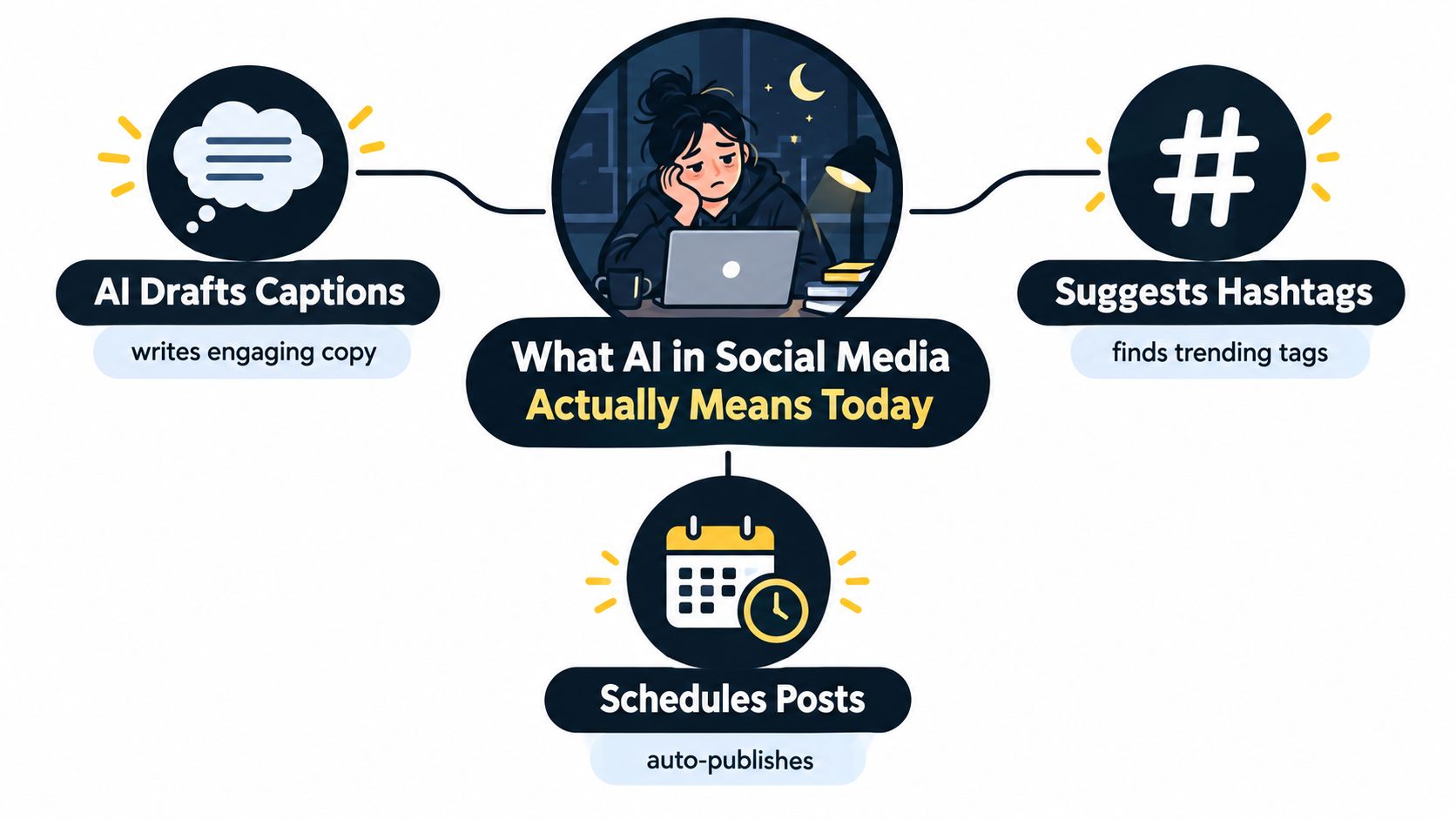
A lot of people hear “AI” and think only of caption generators. That's too small. AI in social media now stretches across the whole workflow, from the first content idea to the moment you review reach, saves, replies, and watch time.
In plain English, AI used in social media means software systems that can spot patterns, generate content, rank what people see, label or filter risky material, and help marketers decide what to publish next. On a platform side, AI shapes feeds, Reels recommendations, moderation queues, and ad delivery. On a creator side, AI helps with ideation, scripts, visual edits, hashtag suggestions, scheduling, and analysis.
What changed is scale. In a 2026 survey, 89.7% of social media marketers said they use AI at least several times a week and 64.1% said they use it daily. The same report found 59.5% use it for analytics and reporting, 59.5% for content ideation and trend research, 69.2% use chatbots or conversational AI tools, and 59% use visual AI tools according to Sociality's AI in social media marketing report.
What creators usually get wrong
The common mistake is treating AI like a magic post machine. That usually leads to bland captions, recycled hooks, and content that sounds like it was written by a very eager intern who has never met your audience.
A better mental model is this:
- AI is a research assistant when you need trend patterns.
- AI is a rough-draft writer when you need a starting point.
- AI is a formatter when you need one idea turned into multiple formats.
- AI is a mirror when you need to understand what's working.
Practical rule: Let AI do the first pass and the pattern spotting. Keep final taste, framing, and judgment for yourself.
If you want a broader marketing view before going deeper into creator workflows, AI for social media marketing is a useful next read.
Why this matters right now
AI has moved from side experiment to daily workflow. Another 2026 study found 95% of social media professionals reported using AI at work, 74% said they use it every day, and nearly 6 in 10 had been using it for over a year, based on Metricool's state of AI in social media study. That tells you something important. The market is past curiosity.
But usage and results aren't the same thing. The skill now is knowing where AI improves content quality, where it mainly saves time, and how to connect those pieces into one clean workflow instead of juggling a pile of disconnected tools.
Seven Core Ways AI Powers Social Media Platforms
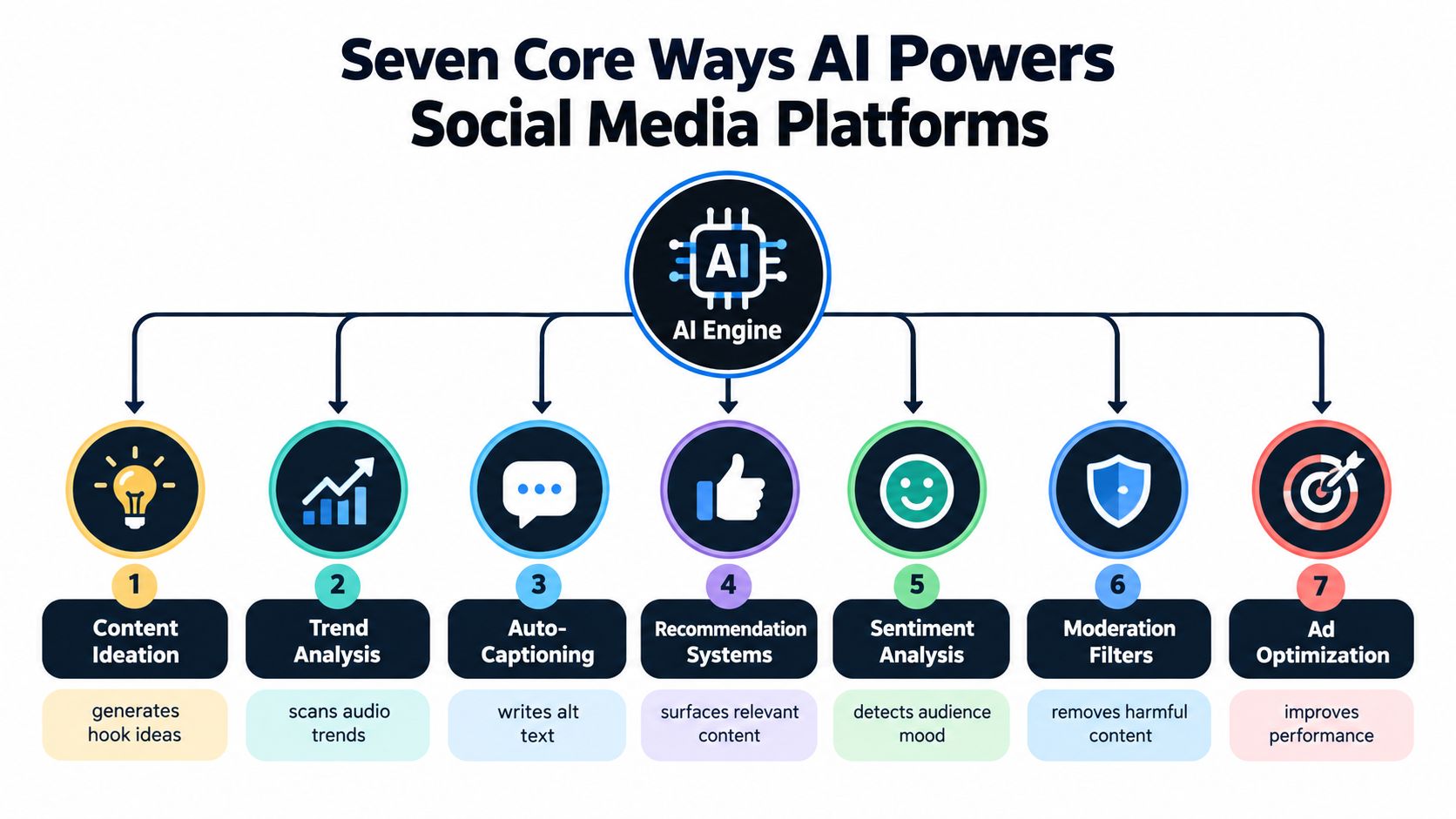
When people say AI is “everywhere” in social media, they're usually bundling together very different jobs. That's why the category gets confusing. One AI system writes captions. Another decides what appears in your feed. Another flags unsafe content. Another tests ad combinations behind the scenes.
The seven layers creators actually deal with
- Ideation enginesThese systems scan patterns in topics, sounds, comments, and formats. They help answer, “What should I post this week?” For creators, hook ideas, trend matching, and niche topic prompts come from.
- Writing assistantsThese generate captions, short scripts, CTA variations, post rewrites, and platform-specific versions of the same idea. They're useful when you know the point but can't get the wording moving.
- Visual generation and editingThis includes thumbnail ideas, background cleanup, subtitle generation, scene trimming, and image assistance. Think of it as the production desk of the stack.
- Recommendation systemsThis is the algorithm most creators mean when they say “the platform pushed my post” or “my reach died.” Recommendation models rank content for feeds, Reels loops, suggested accounts, and non-follower discovery.
- Moderation filtersThese scan text, image, and video content for spam, abuse, policy violations, and risky material before or after publishing.
- Analytics and attribution layersThese help marketers connect output to outcomes. Which hook held attention? Which format drove profile visits? Which carousel topic earned saves?
- Ad optimization systemsThese models test audiences, creative combinations, timing, and bids to improve delivery efficiency.
Where the overlap gets messy
These layers don't sit neatly in separate boxes. A single post might touch several at once. You draft a Reel with AI, a platform recommendation system decides who sees it, a moderation layer checks it, and an analytics layer tells you whether the hook worked.
That's also why many creators end up with tool sprawl. One app for ideas. One for scripts. One for scheduling. One for analytics. If you're comparing setup options, it helps to look at resources on content distribution automation tools, because distribution is where many workflows start breaking apart.
A useful question isn't “Which AI tool writes posts?” It's “Which parts of my workflow are disconnected, repetitive, or blind?”
AI isn't just for organic posts
A lot of creators separate “content AI” from “ad AI,” but platforms don't. The same ecosystem that recommends a Reel also powers ad ranking and targeting logic in paid campaigns. That's one reason organic testing often informs paid strategy and vice versa. If you want a practical paid-media angle, AI in advertising examples shows how that crossover works.
Content Ideation, Scripts, and Creative Production
The most useful place to start with AI is usually not scheduling. It's the blank page.
If you've ever opened Instagram to make a Reel and thought, “I know my niche, but I have no angle today,” you already know the bottleneck. It isn't posting. It's deciding what deserves a post.

Start with gaps, not prompts
Most creators use AI backwards. They open a chatbot and ask for “10 Instagram ideas.” The result is usually broad, forgettable, and easy for anyone else in the niche to copy.
A stronger workflow starts with a profile audit. Look at what you already publish and ask:
- Which format is underused such as Reels, carousels, Stories, or short text posts?
- Which audience question keeps repeating in comments or DMs?
- Which topic gets attention but lacks follow-up content?
- Which platform needs adaptation rather than brand new ideas?
That's where a social media co-pilot is more useful than a generic writing bot. It can look at your existing content, spot weak coverage, and suggest ideas that fit your niche instead of dumping generic prompts on you.
Hooks first, then scene structure
Short-form content lives or dies in the opening seconds. For Instagram Reels, this matters even more because length affects discoverability. Instagram expanded Reels to 3 minutes in January 2025, according to Social Media Today's coverage of the update. But that doesn't mean longer is better.
Current guidance notes that Reels can technically go longer in some cases, yet Reels longer than 3 minutes are not recommended to non-followers in the Reels tab, based on Socialinsider's breakdown of Instagram Reels length. A separate industry guide cites analysis showing Reels in the 45 to 60 second range performed best on engagement rate and median views, as discussed in FrameOS on how long a Reel should be.
That changes how you script. Don't ask AI for a “full viral script.” Ask for:
- A sharper opener
- A 3-part scene flow
- A stronger payoff line
- A version for 45 to 60 seconds
- A second version for a carousel
One paragraph from a blog or newsletter can become multiple assets:
- A Reel script with a spoken hook and three beats
- A carousel with one idea per slide
- A LinkedIn post with a stronger insight angle
- A Threads or X post with a punchier framing
If profile polish is also part of your creator stack, some people pair content workflows with visual branding updates such as learning how to generate a LinkedIn headshot with AI for a more consistent cross-platform presence.
A good script workflow looks like this in motion:
Repurposing is where AI saves the most effort
This is the least glamorous use case and often the most valuable. AI can take one finished thought and reshape it for Instagram, TikTok, LinkedIn, Threads, and X without making you rewrite from scratch every time.
Keep your point of view human. Let AI handle format shifts.
If you're exploring script-specific tools, top AI video script generators for creators in 2026 compares the kind of tools that help with ready-to-shoot hooks, scenes, and social pacing.
Personalization, Moderation, and Ad Optimization
Most creators focus on what AI helps them make. Just as important is what AI does after the post leaves your hands.
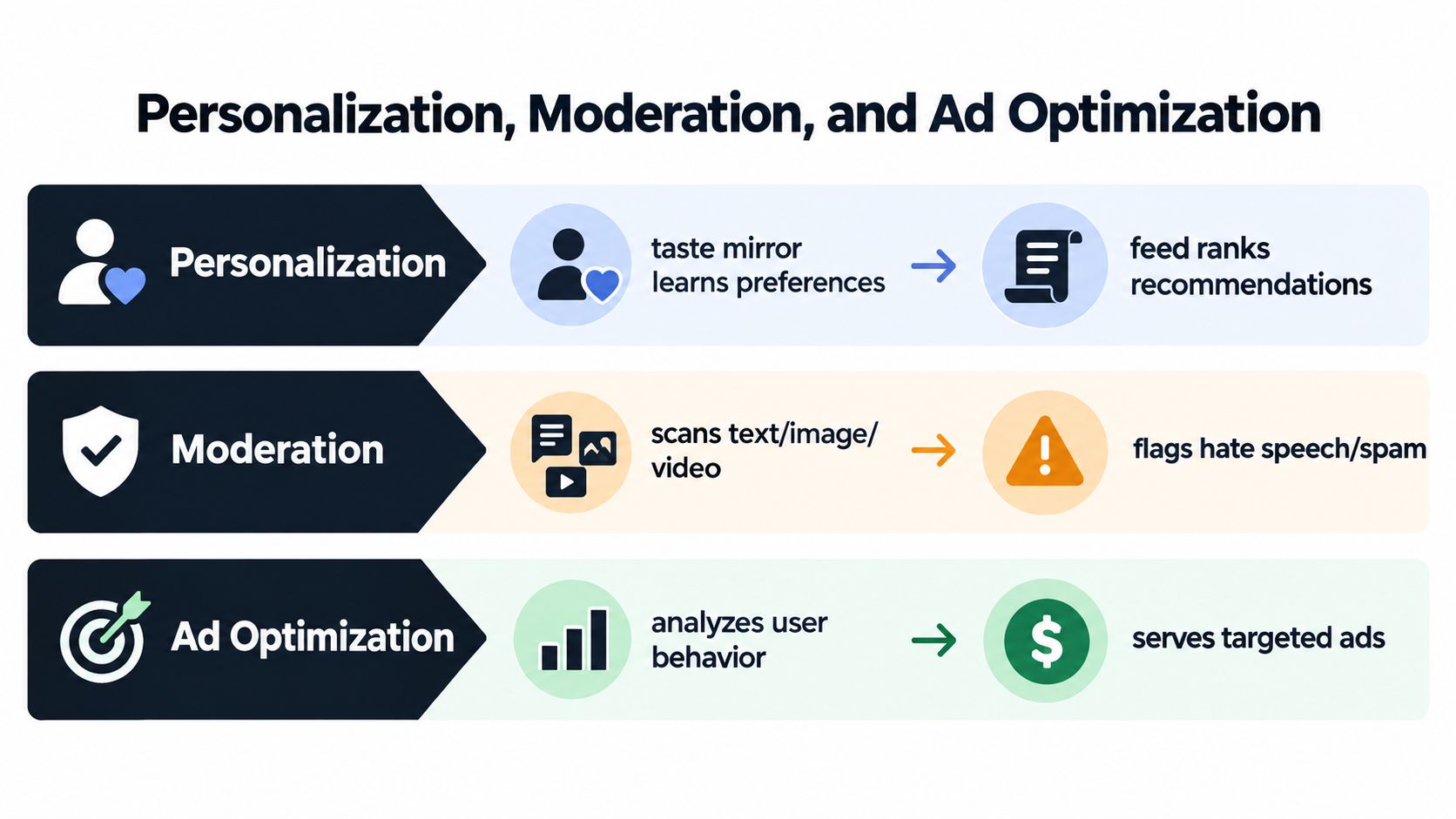
Three systems matter most here: personalization, moderation, and ad optimization. They work in the background, but they shape reach, safety, and cost.
Personalization is a taste mirror
Recommendation systems behave a bit like a librarian who watches what you borrow, not what you say you like. They learn from watch time, skips, rewatches, clicks, follows, and other interaction signals. Then they rank what they think you're most likely to care about next.
For creators, that means your post isn't shown to “everyone.” It's shown in stages to people whose behavior suggests they might respond. That's why a Reel with a stronger hook often gets more chances to travel.
Moderation is layered, not magical
Moderation systems are more like airport security than a single gate. One layer scans text. Another checks images. Another inspects video or audio signals. Easy cases get handled automatically. Messier ones often need human review.
There's a real performance gap across languages. One review reports English-language moderation accuracy at 92 to 94% by 2024, while accuracy for non-Western languages drops to 67 to 84%, according to the review published by Redfame. That matters if your content, customers, or comments span multiple languages.
Independent benchmarks also show model design matters. One comparison found transformer-based systems reached precision, recall, and F1 around 92, 89, and 90.5, with overall accuracy of 94%, versus 78, 72, and 75 with 80% accuracy for rule-based models. The same study reported a hybrid approach reached 91% accuracy and 86.5% F1, based on the moderation benchmark paper hosted on CORE.
Ad optimization is constant testing
Ad AI works like a buyer at an auction who never sleeps. It watches response patterns, compares creative variants, adjusts bids, and tries to put the right message in front of the right audience at the right moment.
Here's the practical takeaway for creators and marketers:
| Area | What AI does well | Where humans still matter |
| Personalization | Finds likely viewers | Shapes the creative angle |
| Moderation | Catches obvious risks fast | Handles nuance, satire, context |
| Ad optimization | Tests delivery patterns | Defines the offer and message |
If you're running campaigns for different audience groups, audience segmentation strategies helps connect this algorithmic side to actual messaging choices.
Systems can sort at scale. They still struggle with cultural nuance, sarcasm, and fresh slang.
How Trendy Threads AI Through the Full Creator Workflow
Most creator AI setups look like a messy kitchen drawer. One app for captions. Another for trend spotting. Another for analytics. Another for scheduling. None of them share much context, so you keep re-explaining your niche to every tool.
The more useful model is a connected co-pilot. One context layer. One feedback loop. One place where your profile data informs ideas, and your results shape the next batch of content.
The old stack versus a connected stack
Here's the old setup many creators know too well:
- A scheduler tells you when to publish
- A script tool drafts a Reel
- A trend tool shows what's hot in your niche
- An analytics dashboard tells you what happened afterward
That works, but it fragments your thinking. The trend tool doesn't know your weak formats. The script tool doesn't know which hook style already underperformed. The scheduler doesn't know which content angle needs another test.
A connected approach fixes that.
The four-part loop
Profile Audit comes first. You connect an account and scan what already exists. The system can look for recurring themes, format gaps, and patterns in engagement.
Trends and Ideas comes next. Instead of generic “viral content ideas,” you want niche-matched prompts, rising formats, likely hooks, and topic angles that fit your audience.
Content Creation is where those signals turn into assets. That includes ready-to-shoot video scripts, hook options, scene structures, carousels, visual post concepts, Instagram and TikTok drafts, plus LinkedIn posts and Threads or X variations.
Performance Analysis closes the loop. You compare what was predicted, what happened, and what to change next time.
That's the reason a cross-format co-pilot matters. The gain isn't just speed. It's continuity.
One example is Trendy, which works as a cross-format social media co-pilot across Instagram, TikTok, LinkedIn, X, and Threads. It ties together profile audit, trend discovery, content creation, and performance review inside one workflow instead of treating them as separate chores. If you're curious about adjacent setups, this guide to automated social media from AI is also worth reading because it shows how agent-based publishing workflows are evolving.
Why shared context matters more than extra features
A disconnected tool pile can produce more output. It usually can't produce better learning. That's the difference.
When one system sees your profile history, your niche, your past post formats, and your results in the same place, it can make more grounded suggestions. Not perfect suggestions. Just less random ones.
That's especially useful for practical creator work:
- Scheduling Instagram Stories and posts
- Planning content calendars
- Running profile audits
- Building ready-to-shoot TikTok scripts
- Reviewing performance without hopping between tabs
Ethics, Authenticity, and Where AI in Social Media Is Heading
The hardest part of AI used in social media isn't writing prompts. It's trust.
People can forgive a clunky caption. They're less forgiving when content feels deceptive, over-automated, or emotionally fake. That matters more now because AI-generated content is no longer rare.
A 2026 analysis reported AI-generated content reached an estimated 52% of all social media content in May 2025, with a projection that it could reach 90% by 2026 if current trends continue. The same source notes that TikTok had labeled over 3 billion videos as AI-generated content by July 10, 2026, and a 2026 survey found 86% of consumers had encountered AI-generated social content, including 66% on Facebook and 44% on Instagram, according to SQ Magazine's roundup on how much social content is AI-generated.
Responsible use looks boring on purpose
Ethical AI practice usually sounds less exciting than growth hacks. That's a good sign.
Responsible creators tend to follow a few simple rules:
- Label synthetic content when the format could mislead
- Review sensitive posts before publishing
- Avoid fake engagement tactics, such as AI-generated comments meant to simulate real community
- Keep brand voice human, especially on opinion-heavy or emotional topics
Trust compounds slowly and breaks fast. AI speeds content production. It doesn't excuse manipulation.
What's likely next
The near future is heading toward more blended systems, not fewer. Text, image, voice, and video generation are already overlapping. Recommendation models will keep personalizing. Platforms will keep adding labels, provenance markers, and policy enforcement around synthetic media.
Creators often assume the race is about producing more. I don't think that's the durable edge. The edge is clarity. Clear voice. Clear values. Clear disclosure when AI played a meaningful role.
The human part gets more valuable
As AI gets better at assembly, human judgment matters more. Your audience doesn't follow you because software can produce paragraphs. They follow you because you notice things a certain way, frame them a certain way, and bring a perspective they can recognize.
That's why the best use of AI in social media still feels collaborative. It amplifies. It doesn't replace point of view.
Key Takeaways and Your First Step with Trendy
A good way to leave this topic is with one practical idea: AI helps most when it follows the full path of your work, not one isolated task.
That distinction matters. A lot of creators start with a caption generator or a hook writer, get a few usable outputs, then stall because the rest of the workflow still lives in separate tabs and separate habits. The stronger setup is closer to having one co-pilot riding along from the first profile check to the post-publish review.
So the takeaway is simple. AI in social media works best as a connected system.
Here's the split that tends to keep people grounded:
AI can help with
- Profile audits that surface weak spots in your content mix
- Idea generation for Reels, TikToks, carousels, and post series
- Hook writing and ready-to-shoot scripts
- Repurposing one idea across multiple platforms
- Trend detection around topics, formats, and recurring patterns
- Performance review after posts go live
- Platform-level tasks such as feed personalization, moderation support, and ad delivery optimization
You still own
- Point of view
- Taste
- Brand voice
- Context
- Final judgment
If you want a first move that stays manageable, start with one account and one repeatable loop.
Install the mobile app, connect one profile, and run an audit. Trendy is available on iPhone and Android. The goal of that first pass is not to stare at metrics. It is to spot the gaps. Maybe your posts repeat the same angle too often. Maybe one format gets attention while another never gets a real test. Maybe your profile says one thing, but your content mix signals something else.
That is usually the moment AI starts feeling useful in a real creator workflow.
For a first experiment, try this sequence:
- Run the audit
- Pull ideas matched to your niche
- Turn one idea into a short video script
- Adapt that same idea into a carousel
- Publish, then review what got attention and why
It works like a kitchen line instead of a pile of appliances on the counter. Each step feeds the next step, so you spend less time restarting your thinking.
If you want to see how those pieces connect before testing the flow yourself, Trendy's all features overview walks through the profile audit, trend detection, content creation, and performance review in one place.
Use the system like a co-pilot you train over time. If a hook sounds flat, revise it. If a script sounds too polished, make it sound more like you. That feedback loop is what turns AI from a disconnected tool pile into a working process.
If you want one place to connect audits, trend spotting, scripts, and post-review across Instagram, TikTok, LinkedIn, Threads, and X, take a look at Trendy.