You know the feeling. You open Instagram to post a Reel, then TikTok for ideas, then your drafts folder, then analytics, and somehow the day disappears before anything ships. An AI social media assistant solves the core problem behind that chaos, it helps you find what to post, shape it for each platform, and learn from what happened without living inside spreadsheets and tabs.
By 2026, the creators who stay consistent aren't the ones with the most free time, they're the ones with a cleaner workflow. That's why the shift from manual posting to a cross-format co-pilot matters so much, especially for Reels and TikTok, where speed, timing, and format details can decide whether a post gets seen or buried.
The Reality of Modern Content Creation
Content creation becomes difficult when one idea has to survive several formats without losing its point of view. A creator may start the morning shaping a Reel hook, rewrite the caption at lunch, then decide whether the concept deserves a TikTok cut, carousel, or text post. Each choice takes attention away from making the next piece.
The pressure is constant
Instagram Reels and TikTok create different production demands. Reels often depend on polished framing, readable text, and a strong opening. TikTok rewards quick testing, timely sounds, and a structure that earns attention before the viewer swipes. A clip can work on both platforms, but copying the same edit and caption rarely gives either one its best chance.
A creator posting four times per week across Instagram and TikTok can fall to one or two posts after rewriting every caption manually. Rushed drafts then fill the gap, and the creator's voice becomes less consistent. The cost is creative energy as well as publishing time.
A better process treats each idea as a small content system. Start with a topic and audience question, develop one strong source concept, then adapt its hook, pacing, caption, and call to action for each platform. Discovery, creation, and analytics should connect closely enough that performance from one format informs the next draft.
A future-proof content strategy playbook such as this guide from MyMentions helps establish that repeatable thinking before you open a caption box.
Why the old process breaks down
Manual workflows also create an authenticity problem. After enough rushed edits, captions begin to sound interchangeable. Creators chase a trend without deciding what they want to say, so the post gains noise but loses a clear point of view.
An AI-assisted workflow can reduce that friction without removing creative judgment. It can surface a promising topic, suggest a Reel or TikTok treatment, reshape the draft for the other platform, and bring performance signals back into planning. This overview of AI used in social media explains how that broader workflow fits together.
Practical rule: if publishing one post requires three tabs, two notes apps, and a calendar reminder, the workflow is too fragile.
A workable creator setup keeps the idea, platform version, publishing decision, and post-mortem connected. Growth then comes from repeating sound decisions instead of rebuilding the process from zero each day.
What Defines a True AI Social Media Assistant
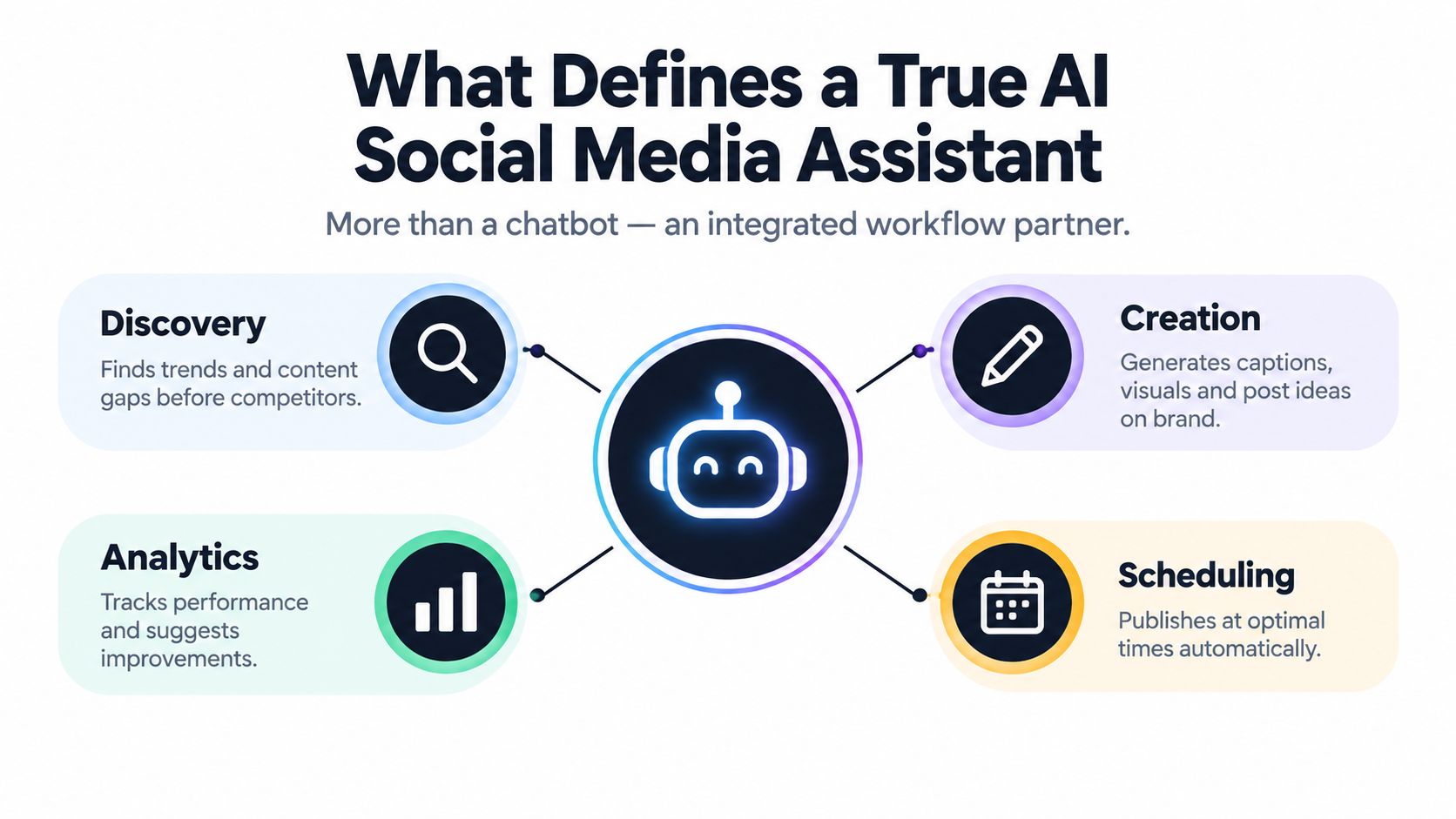
A true AI social media assistant connects the decisions behind an Instagram Reel or TikTok instead of producing isolated captions. It brings discovery, creation, analytics, and scheduling into one workflow, so a trend can inform a hook, the hook can become platform-specific edits, and performance can shape the next idea.
A copilot keeps judgment in the loop
Current usage supports that definition. In a 2026 Sociality.io survey, 89.7% of social media marketers said they use AI daily or several times a week. 59.5% use it for analytics and reporting, another 59.5% for content ideation and trend research, and 69.2% use chatbots or conversational AI tools. Yet 78.4% still edit moderately or extensively before publishing, showing that creators use AI to accelerate decisions rather than surrender them (Sociality.io report).
The same survey found that 28.2% of marketers said more than half of their posts are AI-assisted, while 44.7% said AI-assisted content performs better. 71.1% identified time savings as the biggest improvement. Those results describe a practical role for the tool: draft the first version, expose options, and leave the final voice and edit with the creator.
Connected features matter more than isolated tools
For Reels and TikTok, the assistant should spot a content gap, suggest several opening angles, turn one idea into a short script, and adapt that script for each platform. After publication, it should connect watch time, saves, comments, and other available signals to the next round of concepts. A controlled experiment with 680 U.S. participants found that AI assistance increased engagement and content production metrics. The lowest-friction Chat interface reached 94.4% adoption, indicating that familiar interaction can make assistance easier to use (arXiv experiment).
Human review still affects the outcome. A separate study found that posts combining AI generation with human editing and engagement produced significantly higher interaction, while fully automated versions had low engagement and technical issues (IACIS study). For a practical example of how to boost content with AI posts, the useful question is whether AI supports the workflow, not whether it can generate text on demand.
A good assistant does not make the final call. It makes the next draft clearer.
Four functions, one working loop
Discovery surfaces trends, sounds, audience questions, and gaps worth testing. Creation turns those findings into hooks, scripts, captions, carousels, or visual directions. Analytics shows which opening, format, or topic earned a response. Scheduling gets the approved version published consistently.
A basic generator helps produce copy. A true assistant keeps the idea, platform adaptation, publishing decision, and performance review connected, giving creators a repeatable way to improve both Reels and TikToks.
Mastering Reels and TikTok With AI
A strong podcast clip can underperform because its opening, pacing, or framing does not suit the platform. Instagram Reels and TikTok each reward different editing decisions, so an AI social media assistant should do more than generate a caption. It should connect discovery, production, and analytics, then adapt one idea into platform-ready versions.
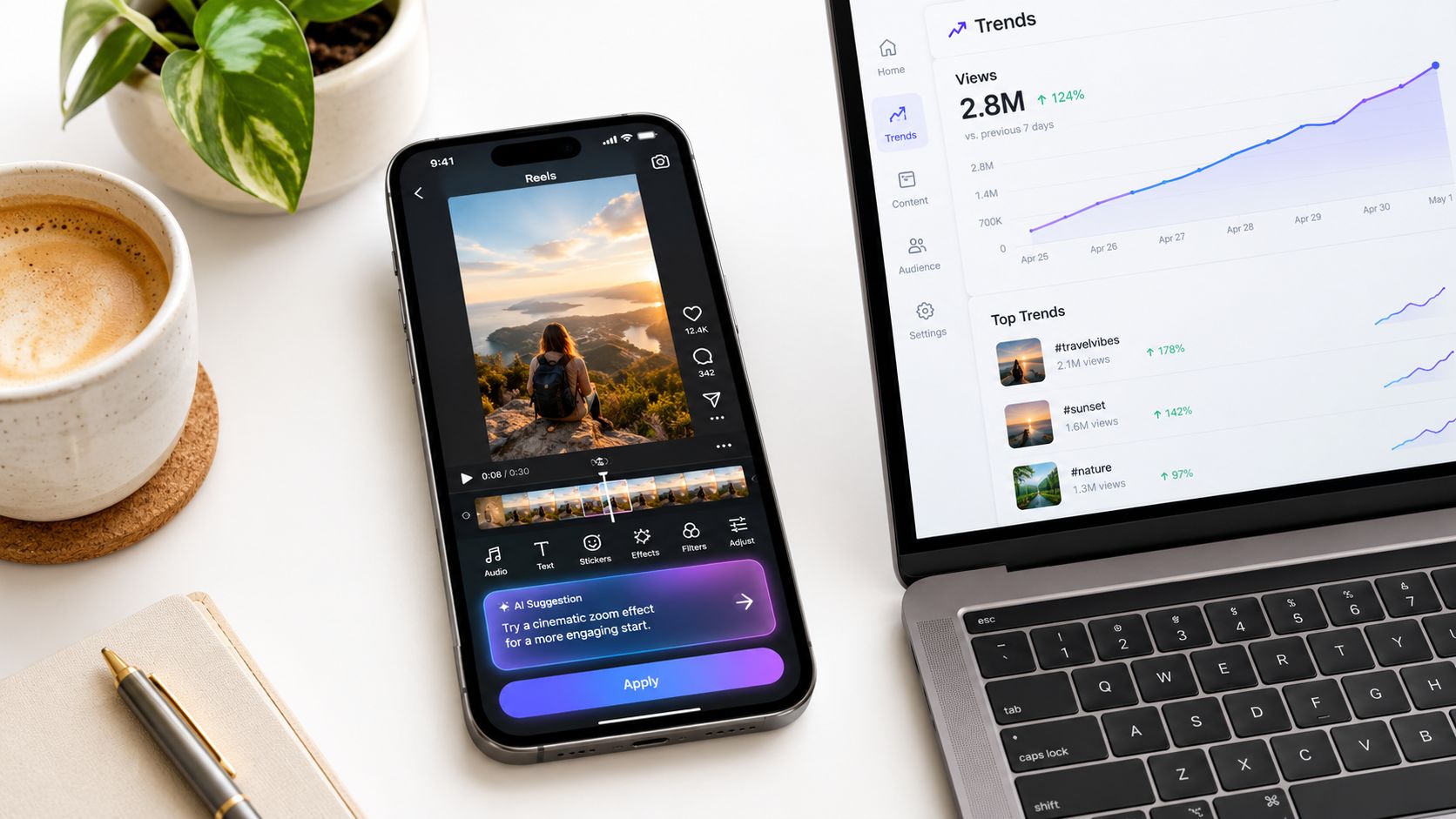
Instagram Reels support vertical 9:16 video at 1080×1920 pixels, with a minimum length of 3 seconds and a recommended 30 fps frame rate. Instagram's help page says Reels can be recorded and edited up to 3 minutes, while some third-party specifications describe longer upload limits depending on rollout (Reel format guide). Clips longer than 3 minutes may be excluded from the Reels tab and are less likely to reach new audiences (Hootsuite Reels guide). Those limits should shape the cut before editing begins, not after the first version is finished.
Hooks determine performance
The first seconds carry the argument for watching. An assistant can generate several opening lines, visual setups, and scene beats for the same idea, then help compare results after publishing. The AI TikTok hook generator guide offers a practical reference for turning a rough concept into shootable hook options.
For example, one podcast clip can become three deliberate variants: a 7-second cold-open hook for Reels, a 15-second sound-synced cut for TikTok, and a caption with platform-specific hashtags. The assistant can track which opening earns stronger retention, then suggest the next variation instead of treating every post as a fresh guess.
TikTok requires the same editorial discipline with a faster response to sounds, formats, and meme patterns. Discovery should identify whether a trend fits the account's audience and offer a usable angle, rather than encouraging imitation for its own sake. Research on which TikTok trends drive conversions helps separate formats that generate attention from those that attract a useful audience.
A platform-specific short-form workflow
Use the assistant to compare the same concept across both feeds:
- Choose the format. Decide whether the idea needs a direct-to-camera explanation, a reaction, a tutorial, or a sound-led edit.
- Build the opening. Generate platform-specific hooks with a visible action, clear promise, or immediate tension.
- Plan the cut. Mark the first visual change, supporting captions, and moments where silence or dead space should be removed.
- Review the signal. Compare retention, saves, comments, and audience fit before producing more versions.
The assistant also limits wasted production. Create several focused variants quickly, test the opening and pacing, and reserve heavier editing for concepts that show evidence of audience interest. That approach keeps Reels and TikTok connected without forcing one cut, caption, or trend onto both platforms.
Building a Complete Content Workflow
A reliable AI setup connects discovery, creation, publishing, and measurement. It starts with the account's positioning, turns relevant signals into Reels and TikTok concepts, and uses performance data to shape the next batch. That connection matters more than adding another isolated tool to the stack.
Start with the profile, not the prompt
Begin with a profile audit. If the bio, positioning, or recent posts send mixed signals, AI will reproduce that confusion in its hooks, captions, and topic suggestions. The assistant needs a clear view of the account, audience, tone, and existing content before it can recommend ideas that belong there.
A structured process also produces better results than random prompting. Feed the assistant your niche and past performance, then ask it to identify content gaps and repeatable themes. The output should fit the audience already following the account, rather than copy a generic viral template. This social media content workflow guide shows how to turn that logic into a working process.
Turn signals into ready-to-shoot content
Once the account is clear, move from discovery to production. The assistant can surface relevant sounds, formats, topics, and angles, then shape them into scripts, hooks, scene structures, captions, carousels, and visual concepts. Reels and TikTok can share an idea while using different openings, pacing, captions, or calls to action.
A practical sequence looks like this:
- Audit your profile. Identify what the account currently communicates.
- Review trend signals. Select formats, topics, and hooks that suit the niche.
- Generate assets. Draft Reels and TikTok scripts, captions, shot lists, and alternate versions.
- Schedule and publish. Set a realistic cadence instead of relying on daily improvisation.
- Study performance. Use retention, saves, comments, and audience response to guide the next round.
The final step keeps the workflow connected to actual results. The market for AI in social media is expanding quickly, with one 2026 industry roundup estimating growth from 3.04 billion in 2025 to 22.4 billion by 2033, a projected 28.37% CAGR, and roughly 80% of organizations worldwide using AI in some form. The same roundup reports that 61% of businesses use AI in social media to reduce manual workload and streamline daily operations (Memeburn roundup).
Practical rule: if analytics do not change next week's plan, they are decoration.
Scheduling closes the loop
Scheduling protects consistency when production gets busy. Instagram native scheduling supports public accounts, photos, carousels, and Reels, allows up to 25 scheduled posts per day, and lets creators schedule up to 30 days ahead (Instagram scheduling workflow). Stories can also be scheduled, but the scheduling tool determines whether polls, link stickers, and music remain available or publish as a plain image (Stories scheduling guide).
A complete workflow therefore runs from account audit to ideas, production, publishing, and review. Each stage should leave useful input for the next one, so Reels and TikTok become a repeatable system rather than a series of urgent guesses.
Trendy vs Manual Effort
Manual posting looks manageable until the week gets crowded and every choice turns urgent. Then you are juggling half-written captions, unposted ideas, and a calendar you do not trust. An AI-assisted workflow turns that scramble into a process you can actually repeat.
The difference shows up in the middle of the week
Manual work slows down right when creators need speed. You are hunting sounds, rewriting captions for each platform, checking whether a Reel fits the format, and deciding which posts deserve a follow-up. AI cuts out those repeat steps, so more of your attention stays on judgment, taste, and community.
The practical gap is easy to see in a real weekly routine. A manual Tuesday can easily become two hours of searching trends, rewriting the same idea for Instagram and TikTok, and adjusting the hook until it feels usable. A co-pilot workflow starts with profile-aware hook suggestions, turns one idea into platform-ready Reel and TikTok variants, and schedules the post once the draft is approved. That changes the job from constant cleanup to focused editing.
As noted earlier, research found human-refined AI drafts outperformed fully automated posts, which supports keeping creator taste in the loop. The point is simple, AI plus creator taste beats automation that publishes without a check on voice or context.
Why the human layer still matters
The human layer protects voice and credibility. AI can draft three hook options in seconds, but you still need to choose the one that sounds like you. It can suggest timing and structure, but you still need to know what your audience has heard too many times already.
That is why creators are shifting toward assistants that handle the full workflow instead of a single task. A tool like Trendy fits that model because it analyzes a profile, surfaces ideas, and creates ready-to-shoot scripts and posts for TikTok, Instagram, LinkedIn, X, and Threads. It works best inside planning, drafting, and review, not as a one-off caption generator.
Manual effort burns out faster
The biggest cost of doing everything by hand is not only time. It is the constant context switching. Once the brain is juggling trends, hooks, captions, thumbnails, and analytics, quality drops even when output volume stays high.
A better system gives you steadier posting with less mental drag. That is what lets creators keep showing up on Reels and TikTok without turning the brand into a treadmill.
Why Creators Are Switching to AI Assistants
Creators do not switch because AI sounds current. They switch because it removes friction from the work that breaks consistency. The value shows up once content is treated as a repeatable workflow for Instagram Reels and TikTok, not as a pile of one-off posts.
Time savings changes the creative budget
The most obvious win is time savings. As noted earlier, marketers in the survey discussed above named it as the top improvement from AI use. That matches creator reality, because every minute not spent rewriting a caption can go into filming, testing hooks, replying to comments, or checking what converted.
A separate roundup pointed in the same direction, saying businesses use AI in social media to cut manual work and keep daily operations moving. The practical takeaway is simple. AI usually improves operations first, and creative output follows once the workflow stops stalling.
Better output comes from better structure
Creators also switch because structured workflows produce steadier output. AI can suggest hooks, tighten captions, and turn rough ideas into usable drafts faster than a blank page ever can. That does not replace taste. It keeps taste focused on the parts that matter, like hook choice, pacing, and whether the post fits the creator's voice.
The strongest assistants combine ideation with analytics. The controlled experiment discussed earlier found that AI support improved engagement and content production metrics, and the lowest-friction interaction pattern had high adoption. That matters because the assistant only helps if creators keep using it.
Lower mental load matters too
Less decision fatigue matters as much as speed. When a tool handles trend discovery, outlines, and performance readouts, creators stop spending energy on small choices and can focus on positioning, storytelling, and replies that build community.
That is where the shift becomes visible in practice. AI is not only about producing more posts. It protects attention, and that protection is what lets a creator stay sharp across both Reels and TikTok without turning the process into a constant grind.
For a closer look at how an AI social media assistant can fit into that workflow, see this overview of AI for social media marketing.
Getting Started With Trendy Today
If your Reels and TikTok process still feels improvised, start by connecting your profile and running an audit. Then move from ideas to shoot-ready scripts, schedule posts, and review what worked so the next post is tighter than the last. For a fuller view of the workflow, see Trendy's features overview. You can try the iOS app at Trendy on the App Store, the Android app at Trendy on Google Play, or use the web app at heytrendy.app.
Trendy helps turn a messy creation loop into a repeatable system for ideas, scripts, posting, and analysis. If you want a clearer way to plan content without losing your voice, build a workflow that keeps pace with you.