You've published an Instagram Reel, recycled it for TikTok, added a Story, drafted a LinkedIn post, and still can't explain what any of it is meant to achieve. That's the moment a social content strategist becomes useful. This professional turns random posting into a repeatable growth system by connecting audience research, platform choices, creative direction, publishing, and performance analysis.
A social content strategist isn't the person with the busiest content calendar. They decide what to publish, where to publish it, how to package it, when to release it, and what the next result should change. The role grew out of the shift from casual brand posting to structured social marketing after the 2010s, and employers now treat it as a strategic function. Salary references place U.S. pay across a broad range of roughly 62,339 to 87,138 annually, while seniority can create a substantial ladder, from a reported 68,000 median total for professionals with less than one year of experience to 133,000 for those with 15 or more years. These figures and the role's development are discussed in Coursera's guide to social media strategist salary.
If you're coming from a creator background, a useful distinction is that a content creator makes the thing, while a strategist builds the system around it. This guide follows that system from the core idea to daily work, measurement, career paths, and a practical Trendy workflow.
Introduction What a Social Content Strategist Really Does
Maya starts Monday with good intentions. She has a phone full of clips, three half-written captions, a TikTok trend she saved last week, and a Story poll she forgot to publish. By lunchtime, she's posted something, but she doesn't know whether it supports her offer, answers a customer question, or escaped because the algorithm was knocking.
A social content strategist solves that problem by turning creative energy into coordinated action. They study the audience, identify useful themes, select platform-native formats, brief or create the content, organize distribution, and read performance data. Their work helps a creator or brand stop asking, “What should I post today?” and start asking, “Which audience problem are we addressing, and what evidence will tell us whether the format worked?”
That's why strategy beats hustle. Hustle can produce more posts. Strategy makes those posts easier to repeat, adapt, and improve.
The job behind the post
A strategist might plan an Instagram Reel with a fast hook, turn the same insight into a TikTok script, reshape the idea into a LinkedIn lesson, and create a Threads or X post that invites discussion. Those pieces can share a central message, but they shouldn't feel like identical copies wearing different hats.
The role sits between creative direction and operational discipline. A strategist may write ready-to-shoot video scripts, suggest carousel structures, identify emerging sounds or hashtags, and recommend a publishing window. They may also review a profile, spot weak positioning, coordinate with a designer or editor, and explain why a post earned attention without generating meaningful action.
Creators who want to understand how production differs from strategy can start with what a content creator does. The distinction is simple: creators make content, while strategists design the conditions that help content serve a larger goal.
Practical rule: If you can't explain the audience, purpose, format, distribution plan, and learning goal for a post, you probably have an idea, not a strategy.
Understanding the Core Concept Behind Social Content Strategy
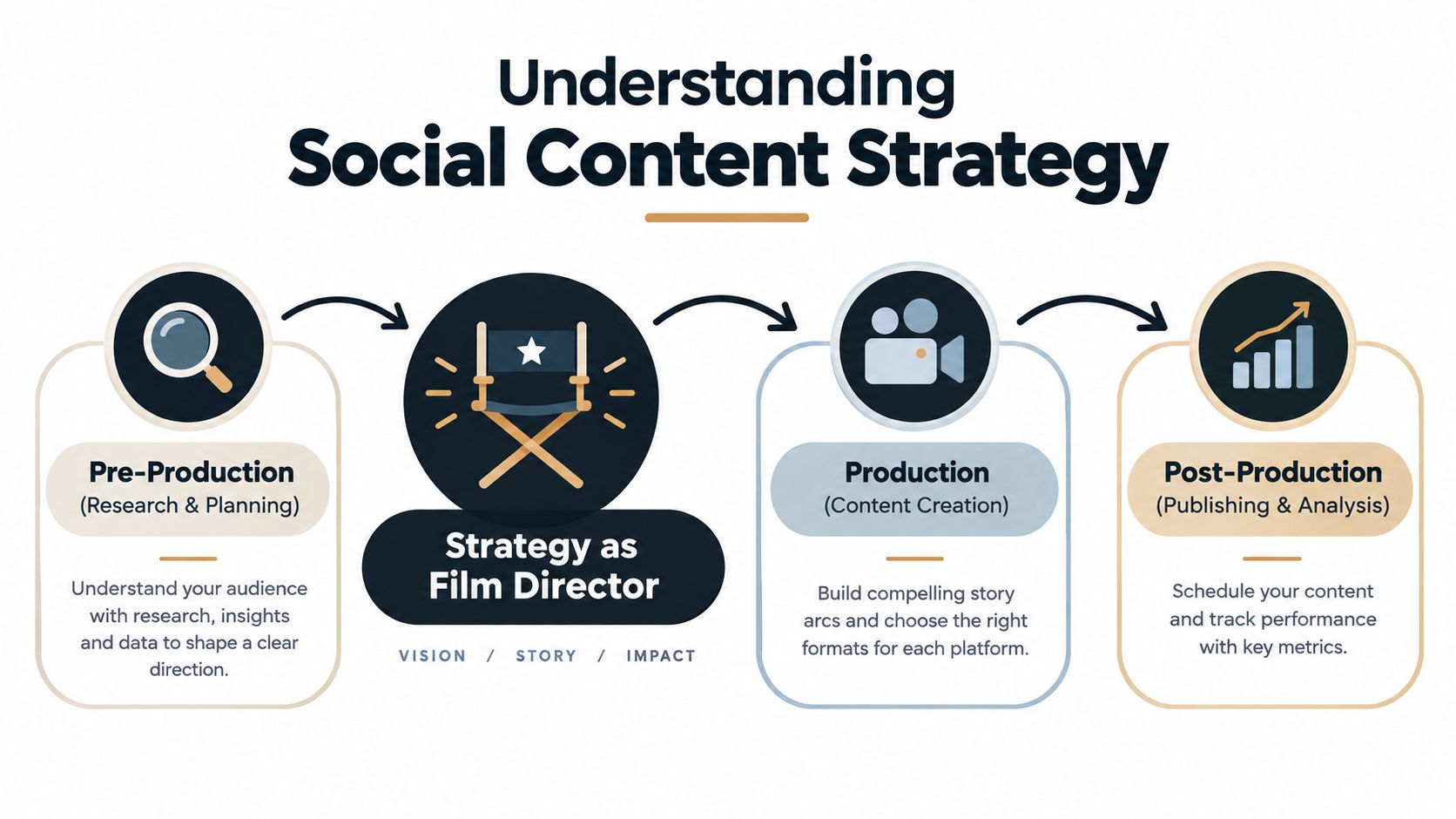
Think of a social content strategist as a film director. The director doesn't arrive on set and tell everyone to “make something engaging.” They understand the audience, shape the story, choose the scene structure, coordinate the team, and decide whether the final cut works for the intended viewers.
Social strategy follows the same pattern. Research is pre-production, content creation is production, and publishing plus analysis is post-production. The strategist connects all three so the work doesn't become a pile of disconnected clips, captions, and graphics.
From posting activity to a growth system
A practical strategy answers four questions:
- Who are we helping? Define the audience's interests, objections, habits, and language.
- What should they understand or feel? Choose a clear message rather than cramming every benefit into one post.
- Which format fits the channel? Use a Reel for visual discovery, a carousel for structured teaching, or a text post for an opinion that benefits from conversation.
- What will we learn? Select a result that can guide the next creative decision.
The platform matters because audiences behave differently in each environment. A TikTok concept may rely on a quick pattern interrupt and native editing, while LinkedIn may reward a clear professional insight. Instagram Stories can support daily interaction, whereas Threads and X can extend a timely conversation through text.
Strategist versus social media manager
The titles overlap, but the emphasis often differs. A social media manager may own publishing, community replies, moderation, and routine channel maintenance. A strategist typically owns the reasoning behind those activities, including audience positioning, content pillars, platform roles, testing priorities, and performance interpretation.
In smaller teams, one person may do both jobs. That doesn't make the distinction useless. It tells you which hat you're wearing at a given moment. When you answer comments, you're operating as a community manager. When you decide which recurring themes deserve production resources, you're thinking like a strategist.
The role became more valuable as brands moved from ad hoc posting toward structured content planning, audience analysis, and optimization after the 2010s. Employers now see social skill as measurable growth work. One salary dataset based on U.S. listings sampled over 36 months reported an average of 75,334 per year from 615 salary submissions**, while other market references place the middle half of earners between **48,000 and $79,000. The figures vary by source and experience, but the direction is clear. Strategy has moved beyond “keep the page active.” A useful companion is this guide to content strategy for social media.
Key Responsibilities and Daily Workflows That Drive Growth
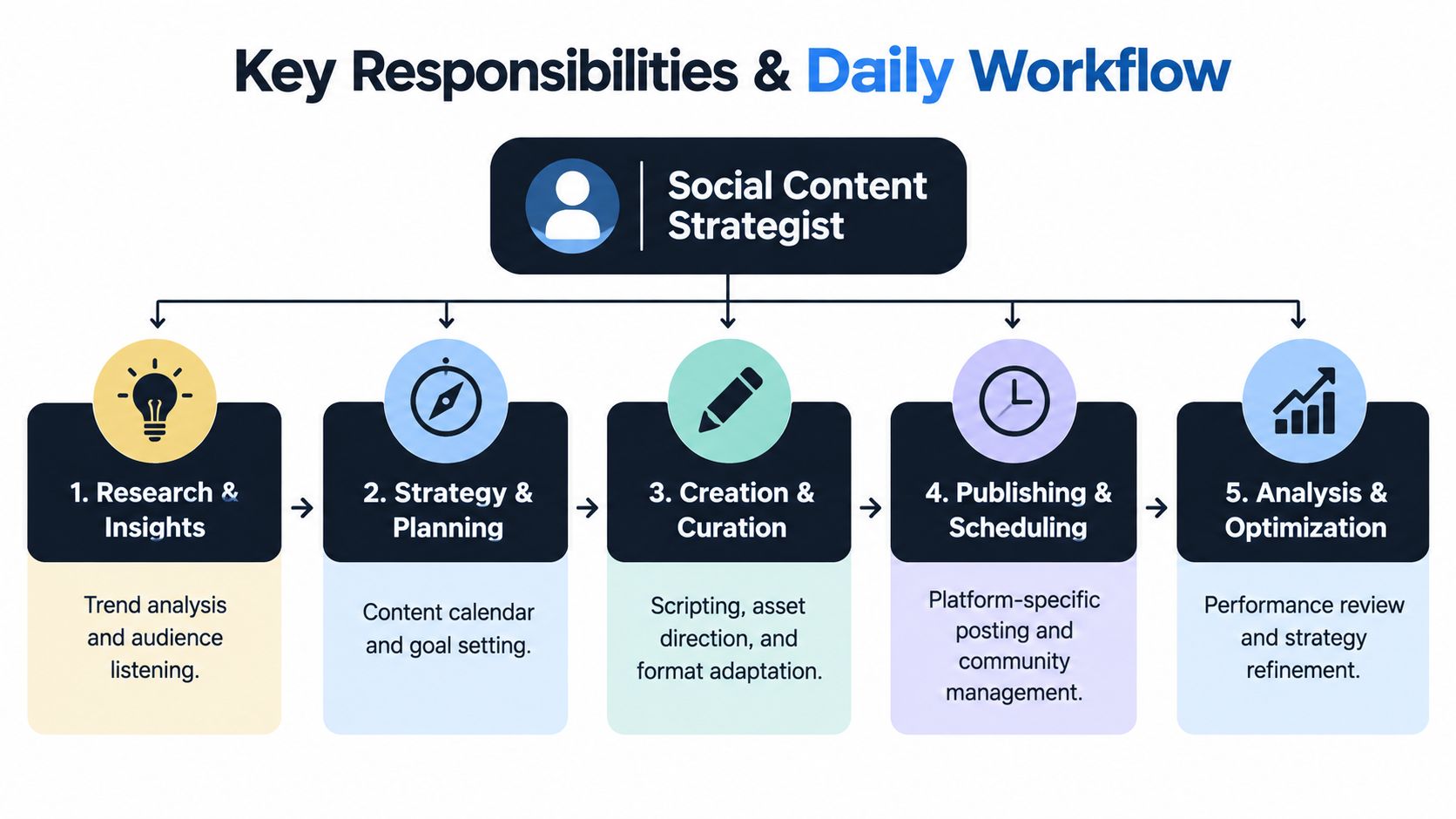
A strategist's day rarely follows a neat “research, create, publish, finish” sequence. Instead, the work loops. A comment reveals a customer concern, that concern becomes an idea, the idea becomes a short script, the post generates new questions, and those questions influence the next planning cycle.
The daily rhythm
A strategist usually begins with signals, not blank-page brainstorming. They check audience replies, review recent performance, scan relevant trends, and look for changes in the platform environment. The point isn't to copy whatever is popular. It's to identify patterns that can be translated into the brand's subject, voice, and available production capacity.
Planning then turns signals into choices:
- Audience insight: What question, frustration, desire, or misconception keeps appearing?
- Content pillar: Which recurring theme can answer that need consistently?
- Format decision: Should the idea become a Reel, TikTok, carousel, Story sequence, LinkedIn post, or Threads/X conversation?
- Creative package: What hook, scene structure, visual, caption, and call to action will make the idea understandable quickly?
- Distribution plan: Which account, time zone, publishing window, and community prompt fit the channel?
Content production follows. The strategist might write a ready-to-shoot script, brief a videographer, guide a motion designer, or adapt a long explanation into several native cuts. When a concept needs polished animation or branded movement, a team may bring in specialist motion graphics studios rather than expecting a generalist creator to handle every production task.
The weekly and monthly loop
Publishing isn't the end of the workflow. A strategist watches the early response, checks whether the hook earned attention, notes where viewers dropped off, and compares the result with the post's original purpose. A post designed for discovery should be judged differently from one designed to encourage saves, profile visits, replies, or conversions.
Monthly work is more architectural. The strategist reviews which pillars are earning useful signals, which formats are costly to produce, which audiences respond to which messages, and where creator partnerships or paid distribution need better measurement. The IAB reports that 71% of organizations increased creator investment year over year, while identifying the right creators remained the top challenge and measurement and operations were named major areas for improvement. That gap explains why modern strategy requires more than taste. It needs selection criteria, testing, attribution, approvals, and a workflow people can maintain.
For a practical operating model, use this social media content workflow as a planning reference. The best workflow is the one your team can repeat without turning every post into a small emergency.
Essential Skills KPIs and How to Measure Success
Strong strategists combine four kinds of judgment. Strategic thinking connects content to a business or creator goal. Platform fluency helps them understand why a Reel, TikTok, LinkedIn post, and X thread need different packaging. Storytelling turns an insight into a sequence people can follow. Data literacy helps them distinguish a promising signal from a flattering distraction.
A strategist who has only one of these skills becomes lopsided. Creative without measurement becomes guesswork. Measurement without audience empathy produces technically tidy content that nobody wants to spend time with.
Match the skill to the signal
A useful report doesn't list every available metric. It chooses the smallest set that can answer the business question.
| Goal | Primary KPI | Supporting Metric |
| Discovery | Reach or impressions | Profile visits |
| Attention | Watch time | Retention pattern |
| Conversation | Replies or comments | Sentiment and recurring questions |
| Consideration | Saves or shares | Link clicks |
| Action | Conversions | Qualified inquiries |
The table is a decision aid, not a universal scoreboard. A short Reel intended to introduce a niche may need reach and watch time. A tutorial carousel may be more valuable when people save or share it. A service post may receive modest public engagement but still generate meaningful inquiries.
Timing is an operational skill
Posting time should be treated as a platform-specific variable, not a universal rule. A 2026 benchmark reports stronger engagement windows around 6 to 9 p.m. on weekdays for Instagram, 3 to 8 p.m. on weekdays for LinkedIn, 8 to 11 a.m. on weekends for TikTok, and 6 to 11 a.m. on weekdays for X, with the recommendation to model timing by network and local audience time zone. See the detailed 2026 social media engagement benchmark for the source context.
Early velocity deserves attention too. A large-scale analysis found that a majority of reactions occur within the first two hours of original posting time on most networks. That doesn't mean a post becomes worthless afterward. It means the launch package matters: a clear hook, recognizable visual, concise copy, relevant timing, and someone available to respond can help the post receive immediate attention. The original analysis is available in this study of timing across 100 million posts.
A strategist also needs judgment around moderation and safety. If comment volume grows, compare workflows and permissions through resources such as tools for ad comment moderation, then decide what should be automated and what requires a human response.
Measurement principle: A KPI is useful only when its movement changes what you'll do next.
For a deeper metric framework, keep this guide to KPIs for social media close to your reporting template.
How Trendy Powers Your Strategy From Audit to Performance
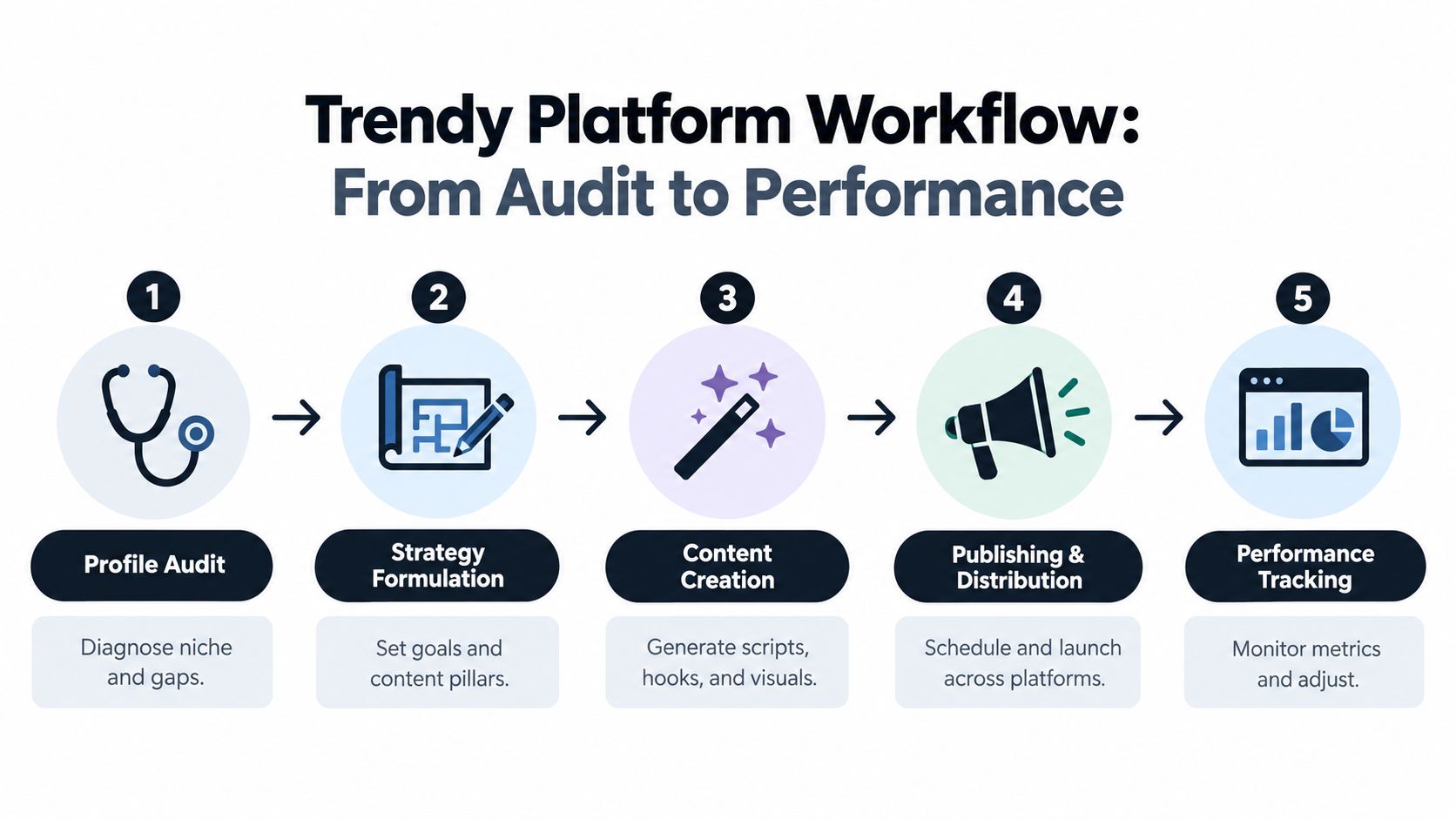
A creator opens the calendar with plenty of ideas, yet the profile still feels scattered. One post teaches, the next follows a trend with no clear connection, and the performance report offers numbers without a useful next move. A repeatable workflow fixes that gap. Trendy works as a cross-format social media co-pilot, helping organize the route from profile diagnosis to content production and review. The strategist remains responsible for judgment, voice, cultural context, and the final publishing decision.
Start with the Profile Audit
Begin with the profile's promise. Can a visitor quickly understand the niche? Does the bio tell the intended audience what they will receive? Do recent posts reinforce that promise, or do they resemble unrelated experiments?
Trendy examines a connected profile's niche, audience, and current performance to identify gaps and opportunities. That gives you a working diagnosis before you plan. It also replaces a mood-based grid review with evidence you can discuss, test, and revisit.
Turn signals into Trends and Ideas
The next job is selection. A strategist looks for ideas that fit the category instead of copying every visible trend. Trendy can surface personalized post concepts, hooks, emerging sounds, hashtags, and video formats for Instagram, TikTok, Threads, and X.
Treat the output as a shortlist, not a finished strategy. A trend is raw material. Check whether the sound supports the message, whether the format fits the audience, and whether the post can carry a recognizable point of view. If those pieces do not fit, leave the trend behind. A popular format cannot rescue a vague idea.
Build the Content Creation package
A promising concept still needs production instructions. Trendy can help create ready-to-shoot video scripts, hooks, scene structures, captions, carousels, visual post concepts, LinkedIn posts, and Threads/X posts. The strategist can then adapt one insight across formats while changing the delivery for each platform, rather than pasting identical copy everywhere.
For Instagram Reels, plan for 9:16 vertical video, commonly 1080 × 1920 pixels, so the composition fills a mobile screen. Reels may run for up to 20 minutes, but videos longer than 3 minutes are not recommended to non-followers and may not appear in the Reels tab. Discovery-focused content therefore often benefits from shorter, hook-led edits. Longer versions can support existing followers who want a fuller explanation. Review the platform details in this guide to Instagram Reels length and the Reels video requirements.
Publish, then analyze the reason
For Stories, Meta Business Suite allows creation from the Planner or Content area. Upload the media, choose Schedule instead of Share now, select the Instagram account, and set a future date and time. Some workflow guides describe staging up to 10 images or videos in one Story sequence before scheduling. Arrange the frames as a small narrative: an opening, a useful middle, and a clear interaction prompt.
Publishing is only the midpoint. Trendy's performance view helps you examine what resonated and why, then carry that learning into the next plan. If repetitive production tasks are becoming a bottleneck, the RenderIO's 2026 automation guide provides added context for organizing content operations.
AI can speed up analysis, idea generation, and planning. Human review protects experience, voice, and sensitive community conversations. A 2026 multi-market study found that consumers in the U.S., U.K., and Australia ranked human-generated content as their top brand priority on social media, while marketers expand AI and creator programs. The same source projects creator marketing spend at 37 billion in the U.S. in 2025 and 44 billion in 2026, making authenticity a practical planning concern. See the wider findings in this 2026 social media content strategy report.
Explore the wider Trendy features overview, or use the Trendy web app with the iOS app on the App Store and the Android app on Google Play.
Career Path Tools and Templates to Get Started
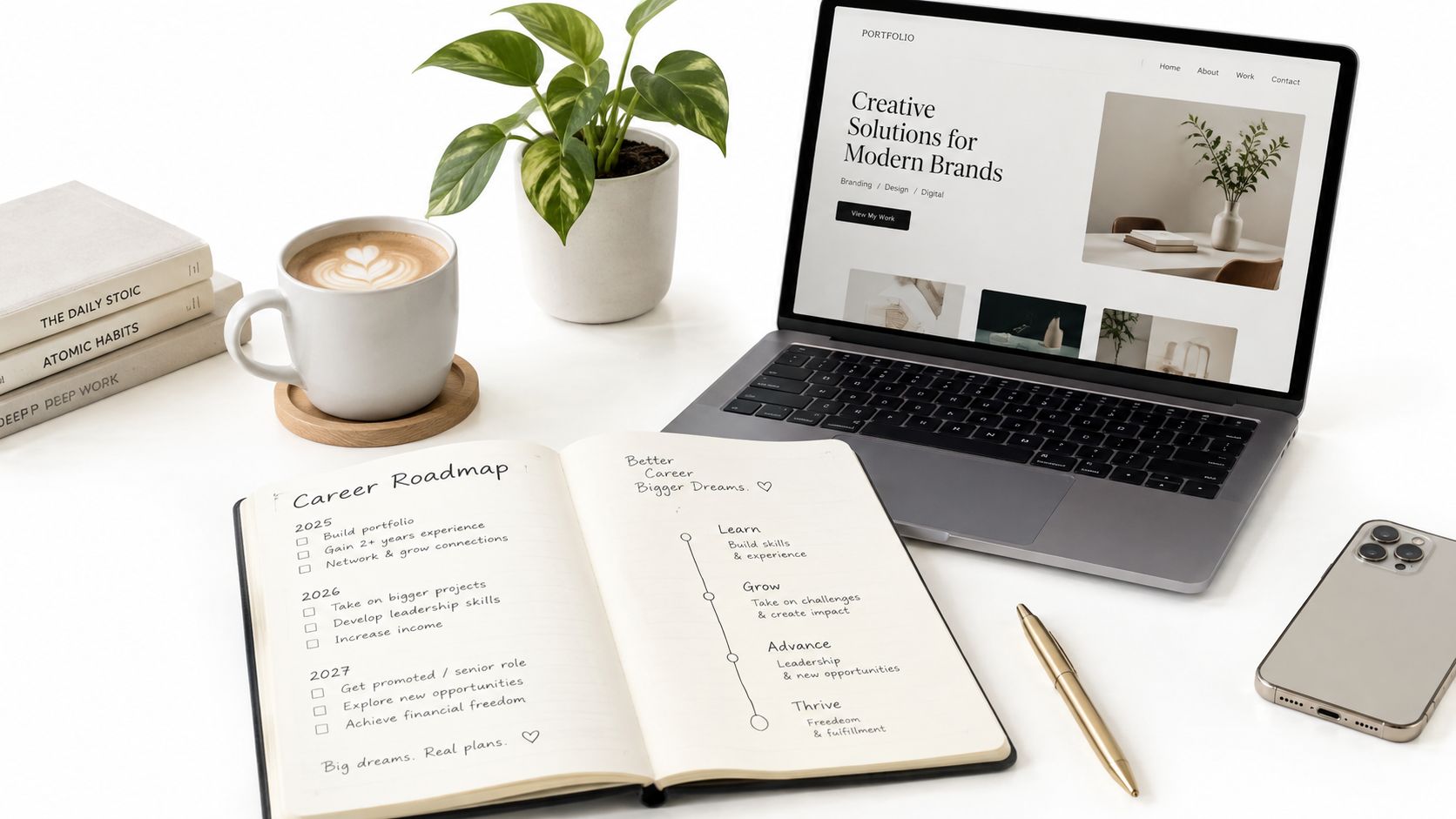
A creator with a small client portfolio can move into social content strategy by documenting the choices behind each post. In-house strategists often arrive from content, community, brand, or digital marketing roles. Agency work can build range quickly because it exposes strategists to different industries, formats, approval processes, and client goals.
The role is established in major markets, with pay varying by experience, location, and employer. Salary aggregators place U.S. compensation in a broad range of roughly 62,339 to 87,138 annually, while recent 2026 estimates report 65,671 average pay on one site and 67,177 on another. Entry-level compensation can sit well below senior pay. Build a portfolio that shows the reasoning and outcomes behind your work, not only attractive screenshots. The salary context comes from Coursera's 2026 salary guide.
Choose your starting lane
- Freelancer: Build a compact casebook containing a profile audit, content plan, scripts, publishing rationale, and performance review.
- Small business owner: Choose one clear audience, a few repeatable pillars, and formats you can produce without draining your time.
- Agency or in-house candidate: Show how you work with designers, editors, creators, community managers, and stakeholders.
- Creator moving into strategy: Explain each hook, format, timing, and revision. Your portfolio should reveal a method, not present every decision as instinct.
A practical toolkit might include a content calendar, native platform analytics, an editing app such as CapCut or Adobe Premiere Rush, a notes system, and an AI co-pilot for research and planning. Trendy can support that co-pilot role with profile insight, trend discovery, content ideas, scripts, posts, and analysis across social formats. Use AI for speed, then apply human judgment to keep the voice and audience connection genuine.
Use this short strategy brief for practice:
- Audience: Who needs this?
- Problem: What are they trying to solve?
- Promise: What will they understand or do after engaging?
- Format: Why does this channel and format fit?
- Hook: What earns the first moment of attention?
- Signal: Which KPI will guide the next decision?
A strong portfolio proves you can build a repeatable system, from a clear brief to a measured result, rather than produce just one polished post.
Your Next Move as a Social Content Strategist
A busy morning can make social strategy feel like improvisation: one post is due, a trend is moving, and nobody knows what to make next. Replace that scramble with a system. Your inputs are audience needs and brand positioning. Your choices are topics, formats, and timing. Your feedback is performance and conversation.
Begin with an audit. Find gaps in the profile, audience, and positioning. Choose a focused set of content pillars, turn each into platform-native formats, publish when people can respond, and study the result. The next cycle should start with a better question, not a blank page.
AI shortens the distance between an idea and a draft. Human judgment keeps the work credible. You decide whether a trend fits the brand, whether a script sounds like a person, whether a joke respects the audience, and whether a comment needs empathy rather than automation. A strategist builds the rails, then leaves room for genuine interaction.
Try one complete workflow: audit a profile, choose one audience problem, create a Reel concept and TikTok script, adapt the insight into a carousel and a LinkedIn or Threads/X post, then give each piece one clear KPI. Review the early response and record one change for the next cycle.
Download Trendy on iOS or Android, or use the web app, to support this workflow. Visit Trendy to audit your profile, find relevant trends, create scripts and cross-format posts, and review performance. Start with one audit and one week of content, then let the results sharpen the next decision.