Short-form video generates about 2.5× more engagement than long-form video, and it now accounts for 58% of all time spent on social media worldwide. The winning strategy in 2026 isn't just to publish more clips. It's to use TikTok for reach, Instagram Reels for interaction, and a workflow that connects attention to action.
That distinction matters because a high view count can hide weak audience intent. TikTok and Instagram aren't interchangeable distribution channels, and the same video can produce exposure on one platform while creating conversations on the other. Effective short-form video marketing starts by deciding whether you need discovery, interaction, product research, or conversion, then building the creative and measurement system around that job.
Why Short-Form Video Is Your New Growth Engine
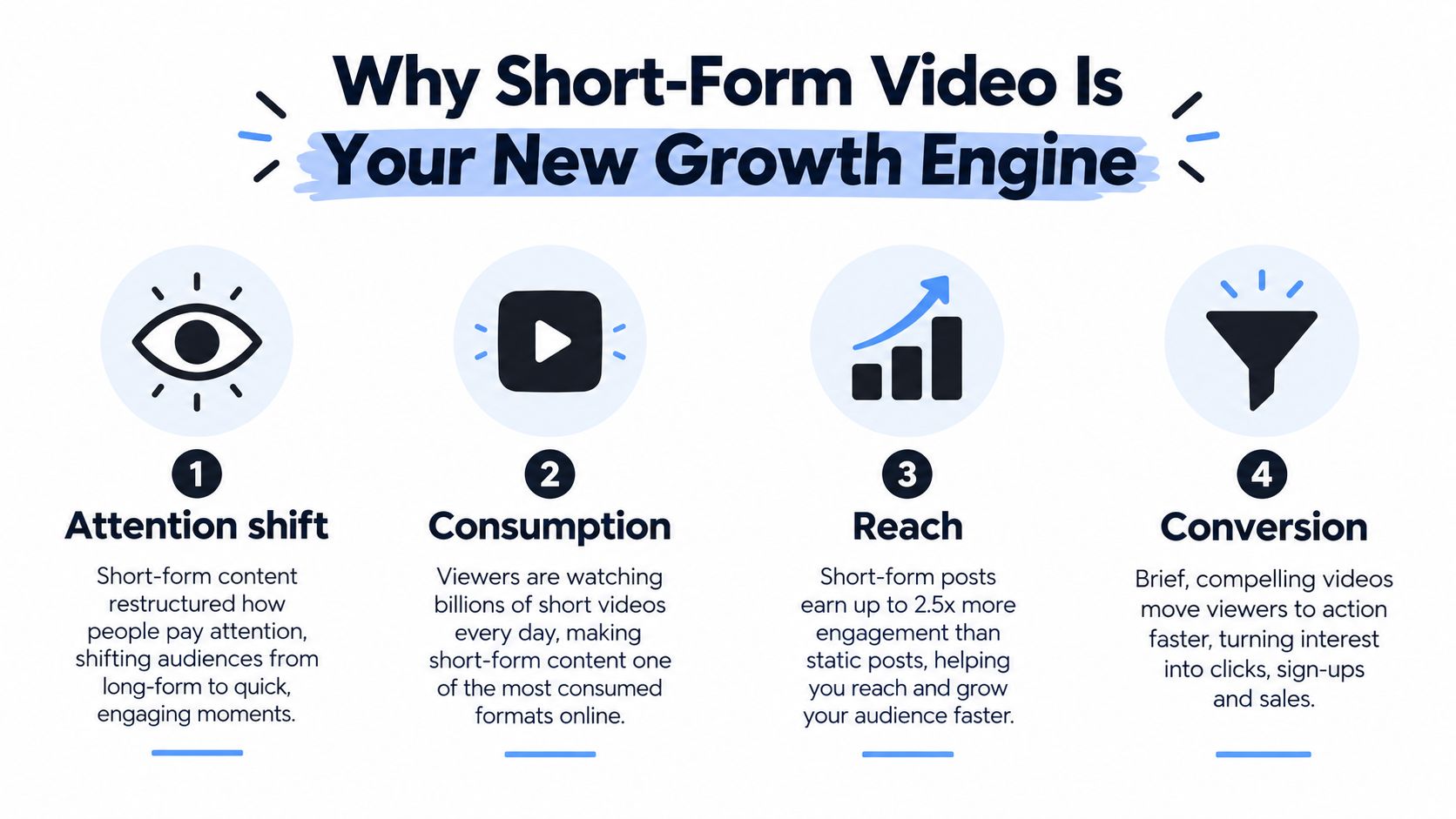
Short-form video has changed the economics of attention. A 2026 industry compilation reports that short-form videos generate about 2.5× more engagement than long-form videos, while 85% of marketers identify short-form video as the most effective social media content format (Kapwing's 2026 video marketing statistics). That doesn't mean every short clip works. It means the format gives brands more opportunities to earn an interaction before a viewer scrolls away.
Attention has moved into the feed
A 2026 summary citing Clutch's 2025 attention-economy findings says 95% of consumers watch short-form video regularly and 71% watch daily (Kapwing's short-form video statistics). The same summary reports that short-form video takes 58% of global social media time. Your audience isn't waiting for a polished campaign to arrive. They're making quick decisions inside a stream of competing videos.
That creates a practical problem for brands still treating video as a quarterly production project. A long introduction, vague positioning, or slow visual setup can lose the viewer before the useful information appears. The first scene needs to make the topic obvious, and the rest of the clip needs to justify continued attention.
Practical rule: Treat the opening seconds as a promise. Name the problem, show the outcome, or create a clear contradiction before you explain anything.
Short-form also expands the number of ways a buyer can encounter your brand. A product demonstration, customer objection, founder opinion, carousel, LinkedIn post, or Threads/X post can all originate from the same insight. The format is not valuable because every message should become a video. It's valuable because one strong idea can be adapted for multiple discovery and engagement environments.
Build for the new attention economy
A useful production system separates the idea from the edit. Start with a real audience question, then decide whether the answer deserves a ready-to-shoot video script, a carousel, a visual post concept, or a written post. Resources on YouTube short video production can help teams think through the production side without turning every clip into a miniature commercial.
For a broader starting point, review short-form video strategy on Trendy's blog. The important shift is operational: stop asking whether your brand “should do video” and start asking which audience problem each format solves. That question leads naturally to platform-specific creative, clearer calls to action, and better performance analysis.
TikTok vs Instagram Reels - Choosing Your Battlefield
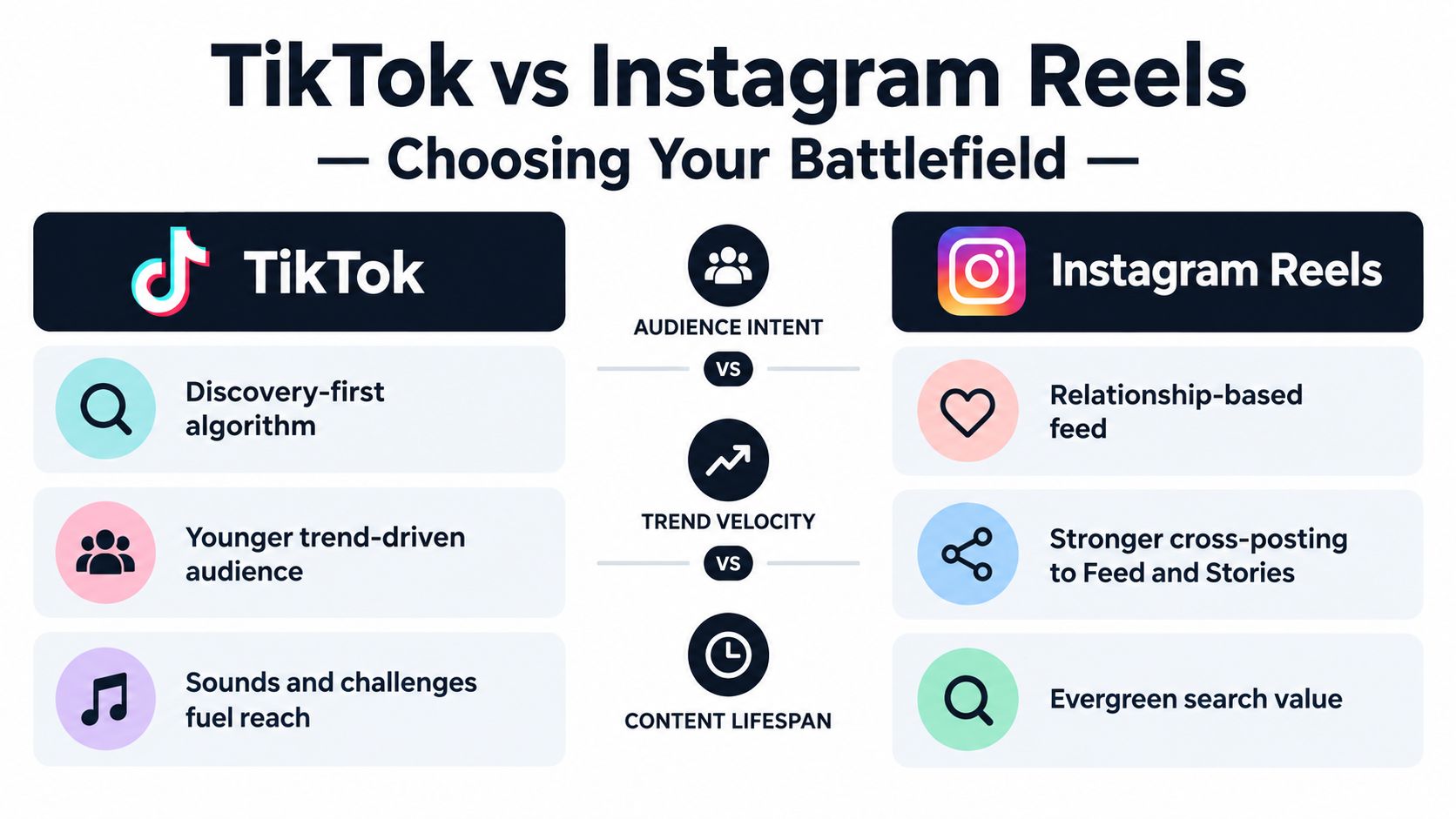
TikTok and Instagram Reels can carry the same raw footage, but they don't solve the same marketing problem. Metricool's 2026 analysis of more than 6 million videos across TikTok, Instagram, and YouTube found that TikTok averaged more than 32,000 views per video, about 46% more than Instagram Reels and 518.3% more than YouTube Shorts (the eMarketer summary of Metricool's analysis).
TikTok is the reach engine
TikTok's advantage is discovery. A viewer doesn't need to follow your account to encounter a relevant clip, which makes the platform useful for testing unfamiliar hooks, trend interpretations, opinions, and problem-solving content. If your primary objective is top-of-funnel exposure, TikTok-native creative deserves its own treatment rather than a simple repost from another channel.
That means using the platform's language without allowing trends to replace a point of view. A sound can attract an initial pause, but the spoken idea, on-screen context, and payoff determine whether the viewer remembers the account. A TikTok content dictation tool can be useful when you need to turn spoken thoughts into a cleaner draft before editing.
Reels is the interaction engine
The same Metricool analysis found that Instagram Reels generated the most comments, shares, and overall engagement among the platforms examined. Instagram therefore makes more sense when the objective is community response, saves, shares, or a stronger relationship with an existing audience.
The distinction changes how you write the ending. A TikTok designed for reach might invite viewers to follow for the next explanation. A Reel designed for interaction might ask for an experience in the comments, present a checklist worth saving, or offer a practical comparison someone will send to a colleague.
| Marketing objective | Stronger starting point | Creative emphasis |
| New audience discovery | TikTok | Native trends, sharp hooks, clear topic framing |
| Comments and shares | Instagram Reels | Questions, utility, relatable experience |
| Cross-format relationship building | Reels connected to Stories, posts, and profile content | |
| Creative experimentation | TikTok | Multiple hook variations and trend-led concepts |
Don't interpret this as a rule to abandon one platform. A service business may use TikTok to introduce a recurring problem and Reels to deepen trust with demonstrations, carousels, and customer-focused explanations. The better approach is to assign each channel a job, then adapt the edit and CTA to that job. Trendy's comparison of TikTok and Instagram offers a useful reference point for making that decision without treating both feeds as identical.
The Length Strategy Behind High-Retention Videos
Video length is a creative decision, not a badge of discipline. Social Insider's 2026 benchmark found that TikTok videos under 30 seconds won on engagement, while views rose steadily with length and saw the biggest jump between 120 and 180 seconds. On Instagram Reels, 45 to 60 seconds and 120 to 180 seconds outperformed other length groups for both engagement and views (Social Insider's video benchmarks).
Those findings create a trade-off. Short clips can make completion and interaction easier, while longer clips can earn more total viewing when the subject gives people a reason to stay. Cutting every idea to its shortest possible version may improve pace but remove the proof that makes the content persuasive.
Choose the length by the job
Use a short edit when the viewer needs one clear insight, visual reveal, or objection handled quickly. Use a longer edit when the subject requires demonstration, context, comparison, or a sequence of steps. A product tutorial that stops before the result isn't efficient. It's incomplete.
A simple planning process helps:
- Write the promise first. State what the viewer will understand or be able to do by the end.
- Mark the proof. List the demonstration, example, screen recording, or explanation that earns the promise.
- Remove setup. Cut greetings, repeated context, and branding that doesn't help the viewer.
- Test length bands. Produce a shorter and a longer version of the same concept rather than guessing which duration will work.
- Reset attention naturally. Change the shot, add a visual example, introduce a question, or shift the on-screen text when the explanation changes.
The hook belongs in the first 1 to 3 seconds, according to the benchmark guidance. It doesn't need to be loud or theatrical. “This is why your Reel gets views but no saves” is often stronger than a generic greeting because it identifies a specific tension.
A longer video isn't automatically a failure. A longer video without new information is.
For creators selling expertise, the most profitable edit may be the one that takes enough time to remove uncertainty. Guidance on how to make profitable videos is useful here because commercial performance depends on clarity, proof, and a reason to act, not just compression. Use Trendy's TikTok length guide when planning variations, then let retention and downstream actions decide which version deserves more distribution.
Building a Creator Workflow That Actually Sustains Growth
Random inspiration is a poor publishing system. A sustainable workflow starts with a profile audit, turns audience signals into ideas, converts those ideas into production-ready assets, and feeds the results back into the next planning cycle.
Start with diagnosis, not posting
A profile audit should answer practical questions. Which topics attract the right people? Which openings lose attention? Are profile visitors given a clear next step? Do your Reels, carousels, Stories, and written posts reinforce the same positioning?
Then move into trends and ideas. Don't copy a trending sound without checking whether it can carry your message. Look for recurring audience questions, emerging formats, useful visual structures, and conversations your niche already understands. The strongest ideas usually sit at the intersection of current interest and a problem your brand can explain better than a generic creator.
Trendy works as a cross-format social media co-pilot in this workflow. It analyzes connected account context, surfaces ideas, hooks, trends, and ready-to-shoot scripts for Instagram and TikTok, and supports planning across short-form video, carousels, visual post concepts, LinkedIn posts, and Threads/X posts. That makes it more useful as a planning layer than as a simple AI video script generator.
Turn one insight into a content set
A single audience question can become:
- A ready-to-shoot video: Hook, scene structure, spoken lines, b-roll direction, and CTA.
- A carousel: One misconception per slide, followed by a practical checklist.
- A visual post: A diagram, comparison, or before-and-after explanation.
- A LinkedIn post: The business implication and a specific lesson.
- A Threads/X post: The sharper opinion, broken into short points.
This approach protects the creative idea while respecting how people consume each format. It also gives your content calendar enough variety to avoid publishing the same message with a different background.
Use this simple loop:
- Profile Audit: Find weak positioning, missing CTAs, and repeatable winners.
- Trends & Ideas: Match audience questions with relevant sounds, formats, and angles.
- Content Creation: Build scripts, hooks, scene plans, carousels, and written adaptations.
- Performance Analysis: Compare retention, comments, shares, saves, profile actions, and meaningful conversations.
The final stage matters most. A post that receives attention but attracts the wrong audience shouldn't become the template for the entire month. Keep the hook if it worked, but change the topic, proof, or CTA when the audience response doesn't support the business objective.
A short demonstration of the planning process can make the system easier to adopt:
Review performance by concept rather than by isolated post. Ask whether the audience responded to the problem, the format, the delivery, or the timing. That distinction gives you a useful next experiment instead of a vague instruction to “post more.”
Mastering Scheduling and Technical Platform Requirements
Strong creative can underperform when the file, duration, or publishing workflow doesn't match the platform. Instagram Reels can be published vertically at 9:16 with a minimum resolution of 1080 × 1920 pixels, and Instagram's current Reels duration ceiling is up to 3 minutes for many accounts (Instagram Reels duration and format guidance).
Export the master file vertically, check text safe zones, and watch the finished video on a phone before publishing. Captions that look comfortable in an editing window can cover a face or disappear behind interface elements in the feed. Longer Reels may also receive less reach, so duration should follow the idea rather than the maximum allowed length.
Build a calendar around constraints
Meta Business Suite is the native option for automatically scheduling Instagram Stories. The workflow is straightforward: create a Story from Planner or Content, upload the media, preview it, choose a future time, and confirm the schedule. Some workflows allow up to 10 images or videos in a Story preview before scheduling (Instagram Story scheduling workflow).
Native scheduling has limits that affect planning. Meta Business Suite supports scheduling as far as 29 days ahead, requires at least 20 minutes of lead time, and allows only one Story to be queued at a time. Music stickers, polls, and quiz stickers aren't supported in scheduled Stories (Meta Business Suite Story scheduling limitations).
That means interactive Stories need a different workflow. Schedule the static or prepared frames in advance, then reserve a manual publishing slot for polls, quizzes, and music-led moments. Put those exceptions directly into the content calendar instead of discovering the limitation minutes before a launch.
Technical checks should happen before the creative review:
- Format: Confirm the vertical frame and readable text.
- Duration: Match the cut to the intended platform and audience behavior.
- Audio: Check voice clarity, captions, and music rights.
- Publishing: Mark which assets can be scheduled and which need manual interaction.
- Destination: Make sure the CTA points to the right profile, product page, or conversation.
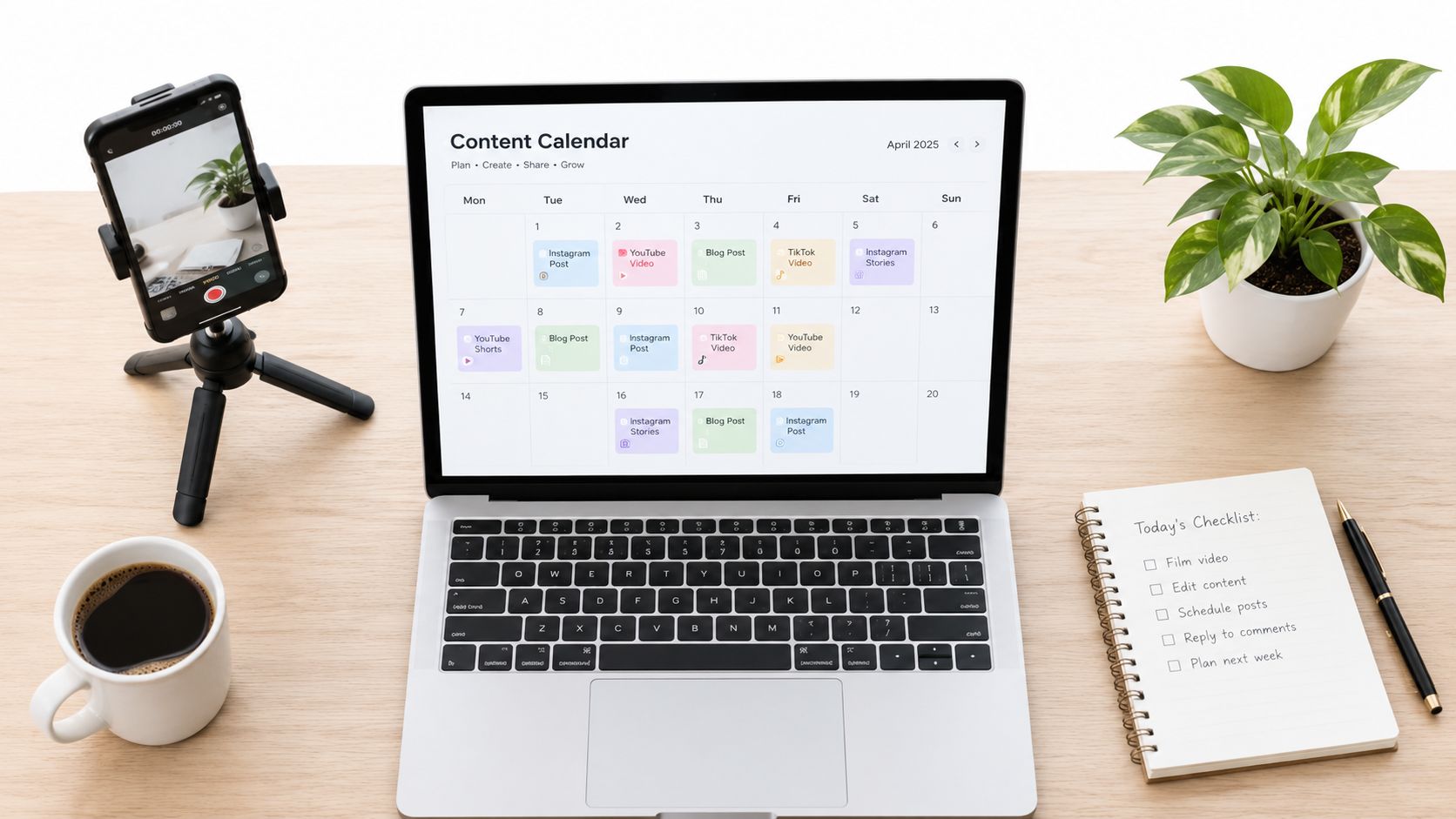
A calendar is more than a list of post dates. It is a production map that shows what must be filmed, edited, approved, scheduled, and published manually.
Connecting Views to Actual Business Outcomes
Views measure distribution, not business value. Short-form video now plays a significant role in product and service research, with 73% of consumers preferring short-form video when researching products or services (Digital Applied's 2026 video marketing data). That preference creates commercial potential only when each video gives viewers a clear route from curiosity to evaluation.
Design the path after the hook
A conversion-oriented clip should connect four parts:
- Recognition: Name the problem using the audience's own language.
- Demonstration: Show the process, result, comparison, or supporting evidence.
- Qualification: Explain who the solution suits and where it may not fit.
- Next action: Direct viewers to a profile, checklist, message, or product page.
The CTA should follow the video's promise. A clip about planning a content calendar can send viewers to a planning workflow. A TikTok versus Reels comparison can point to a platform decision guide. A product demonstration can invite a low-friction product exploration instead of an unrelated newsletter signup.
TikTok and Reels also serve different business jobs. TikTok often creates broader reach, while Reels can generate stronger interaction and more useful signals from an existing audience. Measure each platform against its role rather than judging both by views alone.
Short-form video ad spending reached about 111 billion in 2025** and is forecast to exceed **145.8 billion by 2028, according to the same market data. More spending will increase competition for attention. Creative volume alone will not create an advantage. Audience fit, measurement, and a conversion path that works after the initial view matter more.
Measure the handoff, not just the applause
A useful dashboard separates attention from intent. Track early retention to assess the hook, average viewing behavior to assess the structure, and comments and shares to assess interaction. Track profile actions, site visits, and messages to assess whether viewers took the next step.
For product content, connect each video to a tagged landing page, a specific offer, or a message prompt. Remove the need for viewers to search for the right destination. Review the full journey, from TikTok discovery or Reels interaction to the action that supports revenue.
Trendy's guide to social media ROI provides a useful framework for interpreting that journey. Performance analysis should explain why a post resonated, not merely record that it received activity. A high-reach TikTok may support awareness, while a lower-reach Reel with strong saves, profile visits, or qualified messages may carry greater commercial value.
Measurement principle: Keep the creative metric and the business metric side by side. A hook can win attention while the offer fails to earn action.
Educational, entertaining, and community-led posts all have a role. Identify that role before publishing, then judge the post against the outcome it was designed to produce. Views remain useful, but they are only the first signal in the chain.
Next Steps to Implement Your Short-Form Strategy
Start with one decision: are you trying to increase discovery on TikTok, deepen interaction on Instagram Reels, or move an interested viewer toward a business action? That choice determines the hook, length, edit, CTA, and metric you should prioritize.
Then create a small operating rhythm:
- Audit your profile: Identify unclear positioning, repeated audience questions, and posts worth adapting.
- Choose recurring formats: Use a problem-and-fix video, product demonstration, opinion clip, carousel, or visual explainer.
- Write before filming: Prepare the hook, scene structure, proof, captions, and CTA.
- Adapt by platform: Give TikTok the reach-focused version and Reels the interaction-focused version.
- Review the handoff: Check whether viewers watched, responded, visited, saved, shared, or asked a qualified question.
Don't build the system around daily improvisation. Build a reusable library of hooks, scene structures, content ideas, carousels, LinkedIn posts, and Threads/X angles, then refresh it with performance analysis. Trend discovery matters, but disciplined iteration matters more.
Trendy's web app and mobile experience can support that cross-format process, while the Trendy iOS app and Trendy Android app give creators another way to work with profile insights, ideas, planning, and content direction while they create on the move.
Trendy helps you connect profile audits, trend discovery, ready-to-shoot scripts, cross-format content planning, and performance analysis instead of treating every post as a separate guess. Visit Trendy to build a platform-aware short-form video workflow that turns attention into consistent next actions.