SEO Title: Marketing for Electricians That Books More JobsMeta Description: Practical marketing for electricians focused on booking rate, trust, LSAs, local SEO, Reels, follow-up, and a 90-day plan that turns visibility into jobs.
Most electrician marketing advice still fixates on lead volume. That's the wrong target. Marketing for electricians works when it gets you chosen fast, trusted quickly, and booked without friction. People search on mobile, compare reviews, scan your Google profile, glance at your website, and often decide before they ever call. If your booking path is slow or unclear, visibility alone won't save you. The operators who win usually tighten four things: local presence, paid channel mix, trust-building content, and disciplined follow-up.
Table of Contents
Why Marketing for Electricians Is Won After Discovery
60% of residential customers find their electrician through online search, 30% through referrals, and 10% through repeat work or other channels, according to UK electrician marketing data. That split matters because it changes what good marketing looks like. Visibility starts the job. Booking rate finishes it.
Search gets you into the shortlist. Trust gets you chosen.
Analysts at Valpo Agency found that 89% of home-services searches include location terms and 73% happen on mobile, based on 2025 home-services search patterns. That is a fast decision environment. People are standing in a kitchen with a tripping breaker, or comparing quotes between jobs, and they are not studying ten electricians for half an hour. They check who covers the area, who looks legitimate, and who feels safe to contact.
Discovery is where wasted spend gets exposed
I see the same mistake across trade accounts. An electrician pays for SEO, LSAs, or social content, gets attention, then loses the job in the five minutes after the prospect finds them.
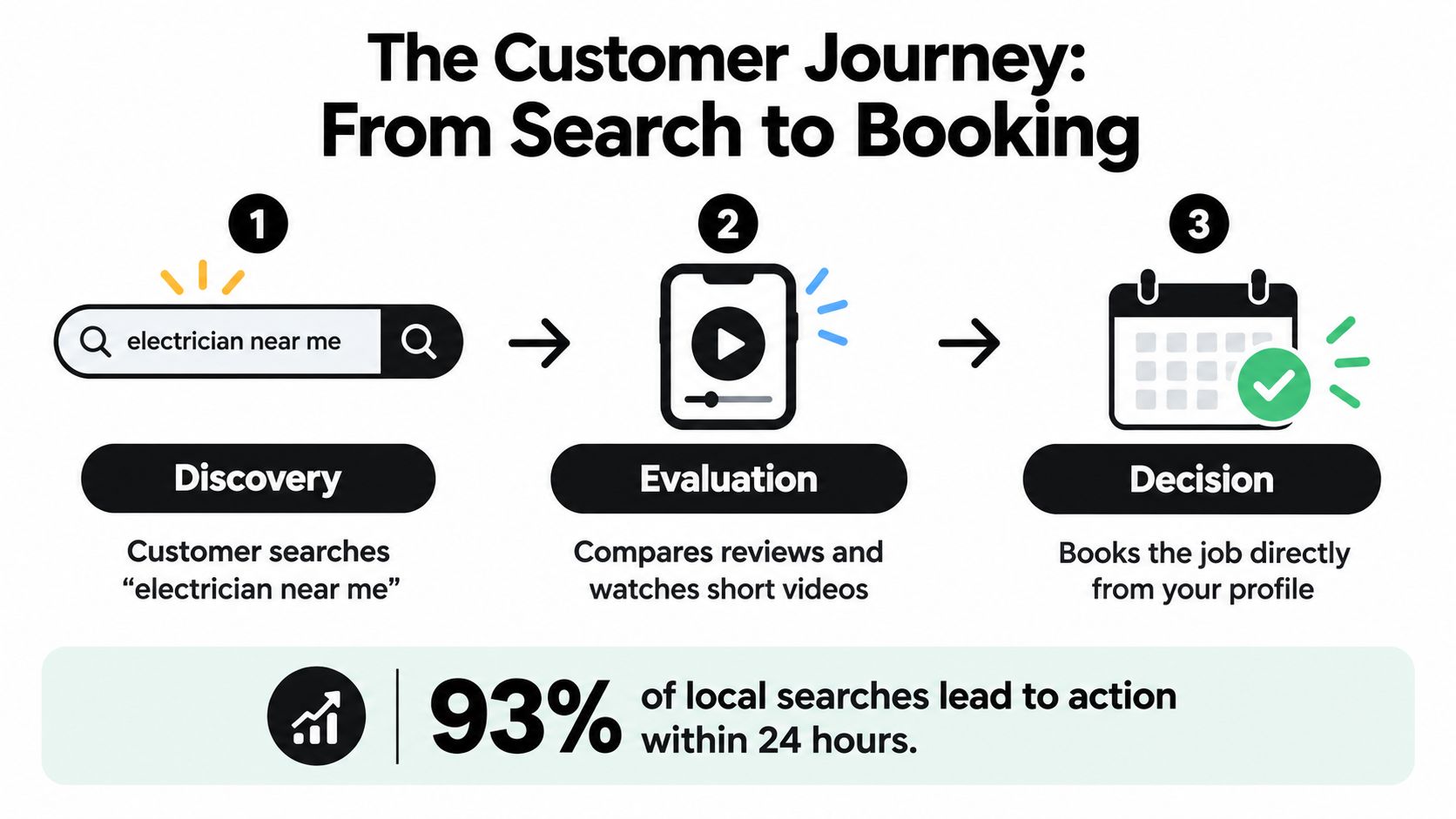
The buyer flow is simple. They search. They scan your reviews, photos, service fit, and service area. They tap your site if they need one more layer of confidence. Then they call the business that looks easiest to trust and easiest to book.
A weak handoff kills good traffic. Missing job photos, vague service descriptions, a slow mobile site, no answer on the phone, or no clear next step will sink performance before price even becomes the issue.
Practical rule: If a homeowner cannot confirm what you do, where you work, and how to book you in a few seconds, your marketing is wasting demand you already paid to create.
Buyers compare risk
Electricians often assume the top position wins. In practice, plenty of local searches show several acceptable options. The buyer is filtering for risk, not chasing the first listing they see.
They look for signals like these:
- Proof you handle their exact job. Rewires, EV chargers, consumer unit upgrades, fault finding, landlord certificates.
- Evidence from real work. Recent photos, short videos, and reviews that sound like actual customers.
- Fast contact paths. Tap-to-call, quote request, and a clear promise on response time.
- Professional consistency. The Google profile, website, and social pages all match and look current.
- A low-friction booking path. No chasing, no confusion, no long wait for a reply.
That is why lead volume on its own is a poor scoreboard. A cheaper lead that never books is still expensive.
The operators who win build for trust conversion
The better frame for electrician marketing is discovery to trust to booked job. Local SEO, LSAs, and short-form video each play a different part in that path.
Local SEO puts you in front of people already searching. LSAs can send high-intent calls, but only if your profile, reviews, and response habits are tight enough to convert them. Short-form video does a different job. It answers the question buyers rarely ask out loud: "Do these people look competent, current, and safe to hire?" If you are working on that side of the mix, this guide on using social media to generate leads for local services pairs well with search-driven channels.
I use a simple operating model for this. Profile Audit → Trends & Ideas → Content Creation → Performance Analysis.
- Profile Audit: Check what the prospect sees first. Google Business Profile, LSA profile, reviews, service pages, photos, response paths.
- Trends & Ideas: Match your offers and content to the jobs people are already asking about in your area.
- Content Creation: Publish proof. Job clips, common fault explanations, upgrade examples, before-and-after installs.
- Performance Analysis: Track booked jobs, cost per booked job, response speed, review growth, and channel quality.
That workflow keeps the focus where it belongs. Not on raw reach. On whether a stranger finds you, trusts you, and books.
Build Your Local Foundation With Google Business Profile and Website
A local search impression is often decided in seconds. The electrician gets the call when the profile looks active, specific, and easy to trust.
Your Google Business Profile and website do that work before anyone speaks to your office. If those assets are thin, old, or vague, lead quality drops and booking rate drops with it. You end up paying for traffic that was never likely to turn into a job.
Get the Google Business Profile right
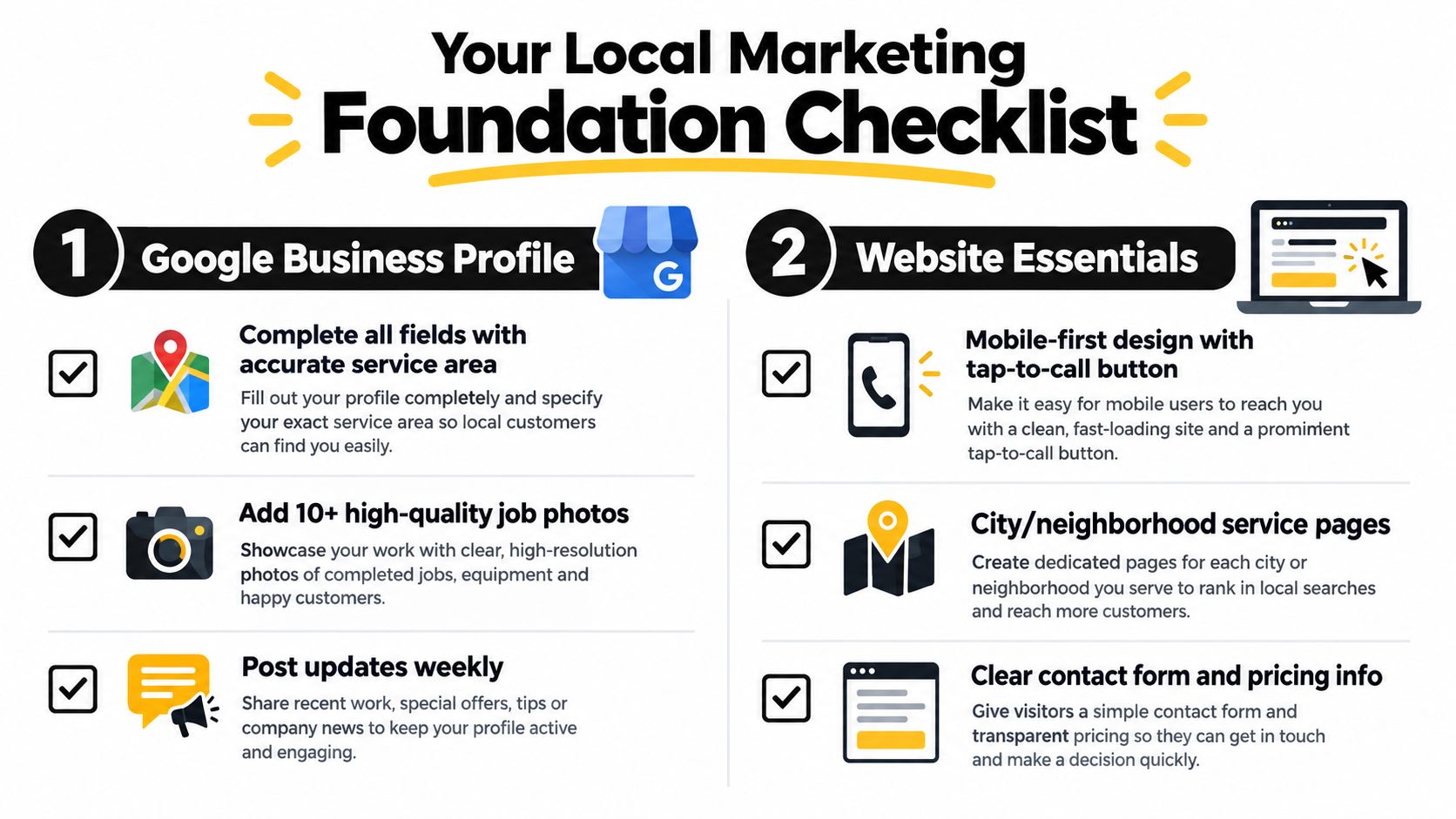
A good profile answers the buyer's first questions fast. Do you cover my area? Do you do this type of work? Are you active? Do other people trust you?
Start with the parts that affect calls and map visibility:
- Service area accuracy: List the towns and postcodes you serve. Wide, messy coverage creates confusion and brings the wrong leads.
- Primary and secondary categories: Choose categories that match the work you want more of, not every job you have ever taken.
- Business description: State your services, service area, and the type of work you specialize in. Keep it plain.
- Hours and contact details: If your listed hours are wrong, you train people not to call.
- Photos: Add real installs, tidy consumer units, lighting upgrades, EV charger jobs, team photos, and branded vans.
- Q&A section: Add the questions customers ask before booking, then answer them clearly.
The difference is obvious in practice. Weak profiles look abandoned. Strong profiles show recent work, clear service detail, and proof that a real operator is behind the listing.
Reviews matter here, but not as a vanity metric. They help the buyer clear the trust hurdle. A profile with recent, specific reviews for the exact job someone needs usually books better than a profile with generic praise and no detail.
Use your website to remove hesitation
The website's job is not to impress other electricians. It is to help a homeowner or facilities contact make a decision on a phone without hunting for basic information.
For most electrical businesses, the structure is simple:
| Page or Section | What it needs to do |
| Homepage | Show service area, core services, trust signals, and a clear contact action |
| Service pages | Cover specific jobs like panel upgrades, fault finding, rewires, EV chargers, lighting, emergency work |
| Location pages | Match the towns or neighborhoods you actually serve |
| Reviews section | Reinforce quality without forcing users to hunt for proof |
| Contact page | Offer tap-to-call, a short form, and service-area clarity |
I have seen plenty of electricians spend on ads while sending traffic to a homepage that says little more than "trusted local electrician." That copy does not answer the core booking question. Buyers want to know whether you handle their exact job, whether you work in their area, and what happens after they call.
Pricing language helps, even when you cannot post fixed rates. Clear wording such as "EV charger site assessment available," "fault diagnosis appointments," or "quotes for panel upgrades" lowers friction because the next step feels defined.
A local trade website should answer four questions fast: what you do, where you work, why someone should trust you, and how to book.
Review generation needs a process
Asking now and then is not a process. It is guesswork.
Use a repeatable review workflow:
- Finish the job and confirm the customer is happy.
- Ask before you leave, while the result is still fresh.
- Send the direct review link by text.
- Follow up once if they said yes and did not complete it.
- Reply to every review in a normal human voice.
That system does two things. It grows review volume, and it improves review quality because the request happens close to the work. Reviews that mention punctuality, fault finding, tidy work, pricing clarity, or an EV install are far more useful than "great service."
Publish pages that match real jobs
Broad service copy attracts broad interest. Broad interest often wastes admin time.
Create pages around the work people search for and the jobs you want to book more often:
- EV charger installation
- Consumer unit or panel upgrades
- Smart-home installations
- Fault finding
- Rewiring
- Outdoor lighting
- Emergency electrician services
Educational content also has a place, especially on higher-consideration jobs. Buyers researching rewires, smart controls, surge protection, or EV charging often need reassurance before they are ready to call. A short explainer on the site can do part of that trust-building before your office handles the lead. If you want a broader framework for tying local pages, short-form content, and lead capture together, this guide to a social media strategy for small business is a useful companion.
Common mistakes on local assets
These problems show up constantly in electrician accounts:
- Generic homepage copy: If the same wording could sit on ten competitor sites, it will not help much.
- No job-specific proof: A buyer looking for a panel upgrade wants to see panel upgrade work.
- Weak mobile layout: Hidden phone numbers, small buttons, and long forms cost bookings.
- Inconsistent business details: Different business info across listings and the site creates doubt.
- No recent updates: Old photos and stale profiles make the business look less active than it is.
The fix is not complicated. Run the same workflow used everywhere else in this article. Profile Audit first. Check the listing, reviews, service pages, photos, and mobile contact path. Then use Trends and Ideas to decide which services and local areas deserve their own pages. Content Creation turns completed jobs into proof. Performance Analysis shows which pages and profile actions lead to calls that book.
That is the local foundation. It does not get applause. It gets more of the right calls, and it helps more of those calls turn into work.
Choose Paid Channels That Book Jobs Not Just Clicks
Google searchers convert at far higher rates than social traffic for most home-service categories, but electricians still lose money on paid media every week because they optimize for lead count instead of booked jobs. The key question is not which channel gets the cheapest form fill. It is which channel produces calls your office can answer, qualify, and schedule.
Paid acquisition starts working after the local foundation is in place. Then the job is to buy intent at the right stage and protect it with fast follow-up.
LSAs and Search Ads do different work
Electricians often throw both under the label “Google ads,” then wonder why results look uneven. The buyer intent is different, the lead flow is different, and the setup mistakes are different too.
Use them for separate jobs:
| Channel | What it does well | Main risk |
| Google Local Services Ads | Captures high-intent prospects who want to call or message now | Weak response handling wastes expensive leads fast |
| Google Search Ads | Wins service-specific demand with tighter control over keywords, copy, and landing pages | Broad match traffic and generic pages drain budget |
LSAs are usually the first paid channel I'd test for an electrician with solid reviews, clear service areas, and someone available to answer quickly. Search Ads come next when the business knows which jobs it wants more of, such as panel upgrades, EV charger installs, troubleshooting, or emergency calls.
That order matters because booking rate usually beats raw lead volume.
Put budget where trust is already high
A lot of electricians spread spend across Google, Facebook, Instagram, YouTube, and retargeting just to feel visible everywhere. That is how small budgets disappear.
Start narrower.
- Fund LSAs first if the profile is strong and the office can respond immediately.
- Add Search Ads next for high-value services and tightly defined local intent.
- Use retargeting and paid social as support once core demand capture is producing booked work.
Paid social rarely creates the same immediate buying intent as someone actively searching for an electrician. It can still help, especially when short-form video builds familiarity before the call, but it usually performs better as trust support than as the first channel to carry the pipeline.
That is where the Trendy workflow fits cleanly. Profile Audit shows whether your reviews, response setup, and service mix are ready for paid traffic. Trends & Ideas helps choose the service angles worth promoting. Content Creation turns completed jobs into proof for retargeting and social video. Performance Analysis shows which channel produced booked work, not just inbound leads.
Budget by job value, not by platform preference
I do not like even budget splits unless each channel has earned it. If service calls are the fastest path to cash flow, put more budget there. If panel upgrades or generator installs produce better revenue and close well from search, shift spend there.
A small shop can start with one paid channel and still grow. A larger operation with dispatch coverage and tighter reporting can run LSAs, Search, and retargeting together. The mistake is paying for traffic before the business can handle the lead path from first call to scheduled job.
Keep the scorecard simple:
- cost per qualified lead
- lead-to-booking rate
- cost per booked job
- average revenue by channel
- close rate by service type
If your reporting stops at clicks or cost per lead, you will miss the channel that makes money. This guide on measuring social media ROI beyond vanity metrics is useful if your paid social and remarketing numbers look busy but unclear.
Why paid channels underperform
Most electrician ad accounts do not fail because Google or Meta “stopped working.” They fail because the business bought intent and then mishandled it.
Common failure points are operational:
- Slow callback times: high-intent prospects keep calling down the list
- Mixed service targeting: one campaign for every service usually weakens message match
- Weak call intake: staff collect names but do not qualify urgency, location, or job type
- No booking priority: emergency and high-value jobs sit in the same queue as low-fit inquiries
- Blended reporting: good channels get cut because all leads are lumped together
I have seen electrician accounts with acceptable lead cost still lose money because half the leads never got a serious follow-up attempt. I have also seen higher-cost channels produce better margins because the office answered fast, the service offer was specific, and the caller already trusted what they saw.
Buy intent. Then convert it.
That is the difference between running ads and building a channel that reliably books jobs.
How benjiads Can Help
Some electricians don't need another agency pitch. They need a system that handles the messy middle between ad launch and lead follow-up. That's where a tool like marketing for electricians can make sense.
Where it fits
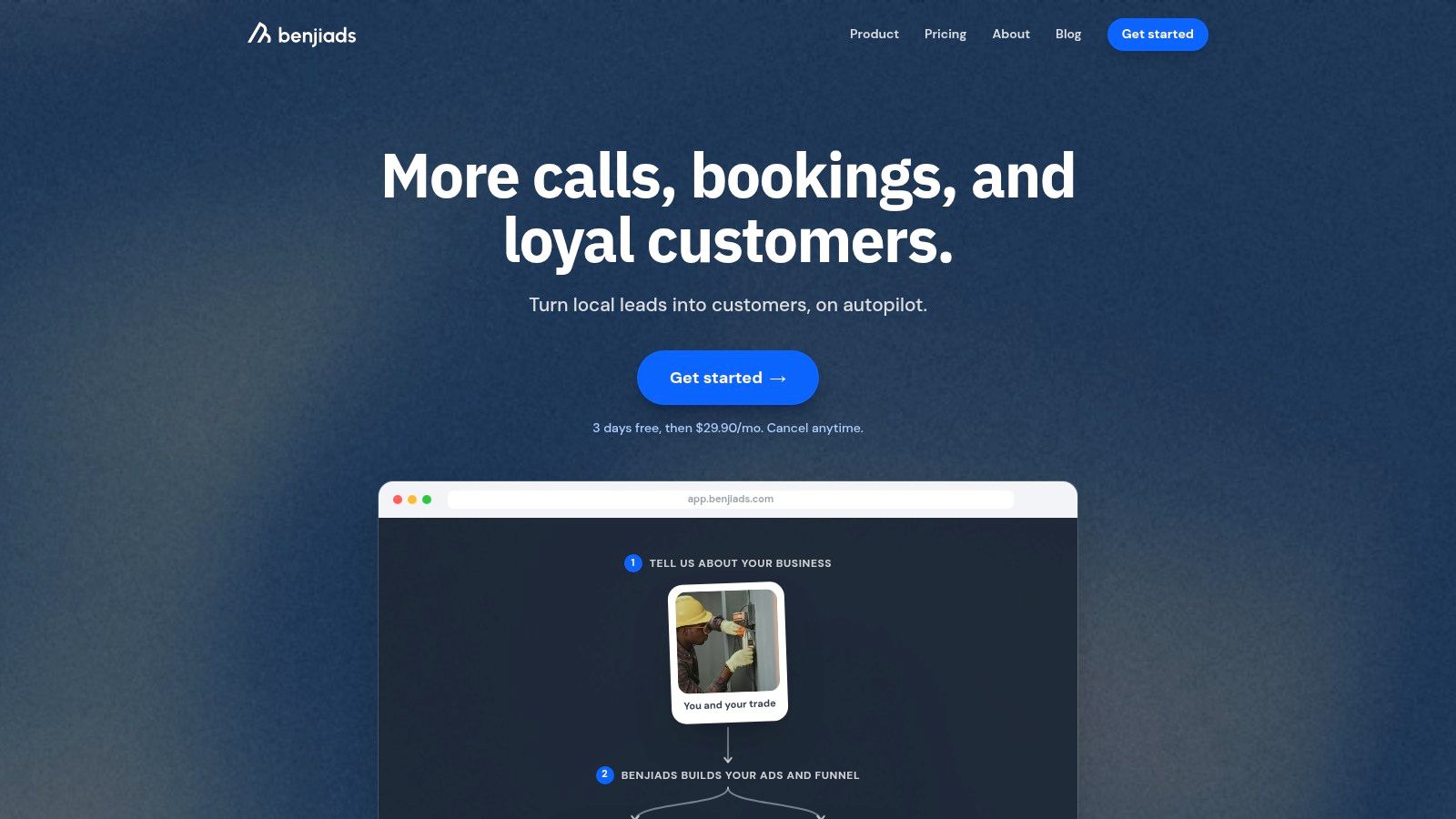
benjiads is software for local service businesses that automates much of the ad setup and follow-up work owners usually struggle to maintain. It generates ad creatives and copy for the trade and local area, launches campaigns on Meta and Google, routes traffic into prebuilt funnels, and uses both server-side and client-side tracking to connect clicks with outcomes. It also follows up with leads by text, with campaigns approved before they run.
That matters when the problem isn't “I've never heard of ads.” The problem is “I don't have time to build campaigns, test creative, wire up tracking, and text leads back while running jobs.”
When it's a good choice
benjiads is more useful in a few specific situations.
You're a fit if you want one stack for creative generation, campaign management, retargeting, attribution, and text follow-up. You're also a fit if you don't want a classic agency retainer model and would rather approve campaigns inside a structured workflow.
It's less about handing your business to a marketer and more about compressing the execution time. A short questionnaire, campaign review, and launch path is easier to maintain than a fully custom process if speed matters.
The real benefit of automation isn't convenience by itself. It's consistency in the steps owners usually skip when the phone starts ringing and the schedule gets full.
The other practical benefit is that it treats follow-up as part of advertising, not an afterthought. That's the right way to think about local lead generation.
Create Field Content That Earns Trust on Reels and TikTok
Short-form video matters because homeowners often check a business twice before calling. They find you through Maps, LSAs, or search, then look for proof that you do clean work, explain things clearly, and show up like a pro. Reels and TikTok help close that trust gap. For electricians, that usually affects booking rate more than raw lead volume.
Keep Reels short and specific
Platform limits change. Electrician content strategy does not.
Short clips usually perform better for local service businesses because they get to the point fast. A homeowner deciding between two electricians does not need a polished mini-documentary. They need a clear problem, a competent explanation, and a finished result. That is why quick panel walk-throughs, before-and-after installs, safety fixes, and common-question videos tend to beat broad branding pieces.
Analysts at Socialinsider and Zeely note that Instagram's length limits and recommendations have shifted. The practical takeaway is simple. For discovery, keep most videos tight, lead with the issue in the first second or two, and earn the watch with specifics.
What to film on real jobs
The best field content is already happening on-site. It just needs structure.
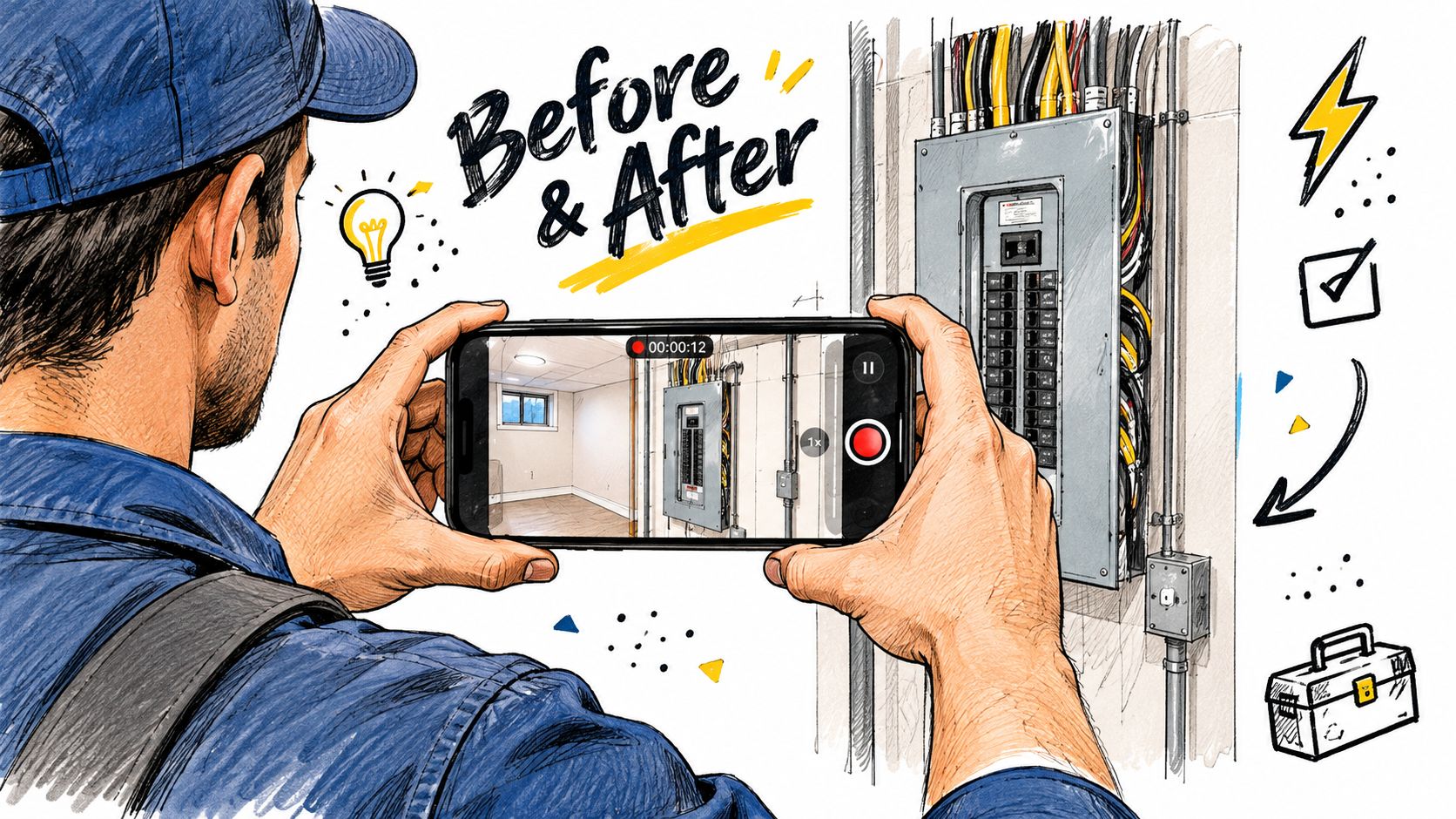
Film the failed GFCI before replacement. Film the overloaded panel before the upgrade. Film the EV charger install with one sentence on why load calculation mattered. Film the testing step at the end, because that shows care in a way generic branding never will.
Good topics usually fall into a few buckets:
- Before-and-after work: Fixture swaps, panel cleanups, service upgrades, troubleshooting outcomes
- In-progress explanation: What failed, what you found, what you are changing
- Customer questions: Why breakers trip, when rewiring makes sense, what causes flickering lights
- High-value upgrades: EV chargers, surge protection, smart switches, panel capacity issues
- Trust signals: Shoe covers, tidy workspace, labeling, testing, clean finish
I have seen electricians waste time trying to sound viral. Better results come from sounding competent.
Reels versus posts for electricians
Use each format for a specific job in the trust cycle.
| Format | Best use |
| Reels | Reach new local audiences and show work in motion |
| Carousels | Explain a process, compare options, or show multi-step jobs |
| Photo posts | Add proof, finished jobs, team presence, and profile consistency |
| Stories | Show daily activity, availability, and quick updates |
Reels help people discover you. Static posts help confirm you are legitimate once they land on the profile. Both matter, but they do different work.
If you want a repeatable bank of prompts, this list of TikTok content ideas for local businesses adapts well to electrical service content.
A simple shooting structure
Use a five-part sequence that matches how customers think:
- Hook“This panel upgrade stopped repeat breaker trips.”
- ProblemShow the issue clearly in one or two shots.
- FixExplain what you changed in plain language.
- ResultShow the completed work and what improved.
- Next stepTell viewers to call, message, or book an inspection.
That structure works because it mirrors the buying decision. People want to know what was wrong, whether you understood it, and whether the result looks solid.
Here's a useful reference example for pacing and presentation:
A workable content workflow
Random posting rarely builds much momentum. A simple operating rhythm does.
The Trendy workflow fits this well. Start with Profile Audit so the page looks credible when new visitors arrive. Use Trends & Ideas to spot topics that match real homeowner questions. Build videos through Content Creation with hooks, scene order, and captions you can shoot between jobs. Then review Performance Analysis to see which clips bring profile visits, messages, and booked work, not just views.
That is the part many electricians miss. Content should support the whole trust path. A homeowner sees the video, checks the profile, searches your name, reviews your site, and then decides whether to call. Good short-form video does not replace local SEO or LSAs. It makes those channels convert better once the customer finds you.
Turn Every Lead Into a Booked Job With Follow Up and Referrals
A lot of electrician marketing fails after the phone rings.
Getting found in search, showing up in LSAs, and posting trust-building jobsite content all matter. The expensive mistake is treating the inquiry as the finish line. Revenue comes from booked work, and booked work usually comes down to response speed, basic qualification, and a closeout process that does not depend on memory.
Build a lead handling chain your team can actually run
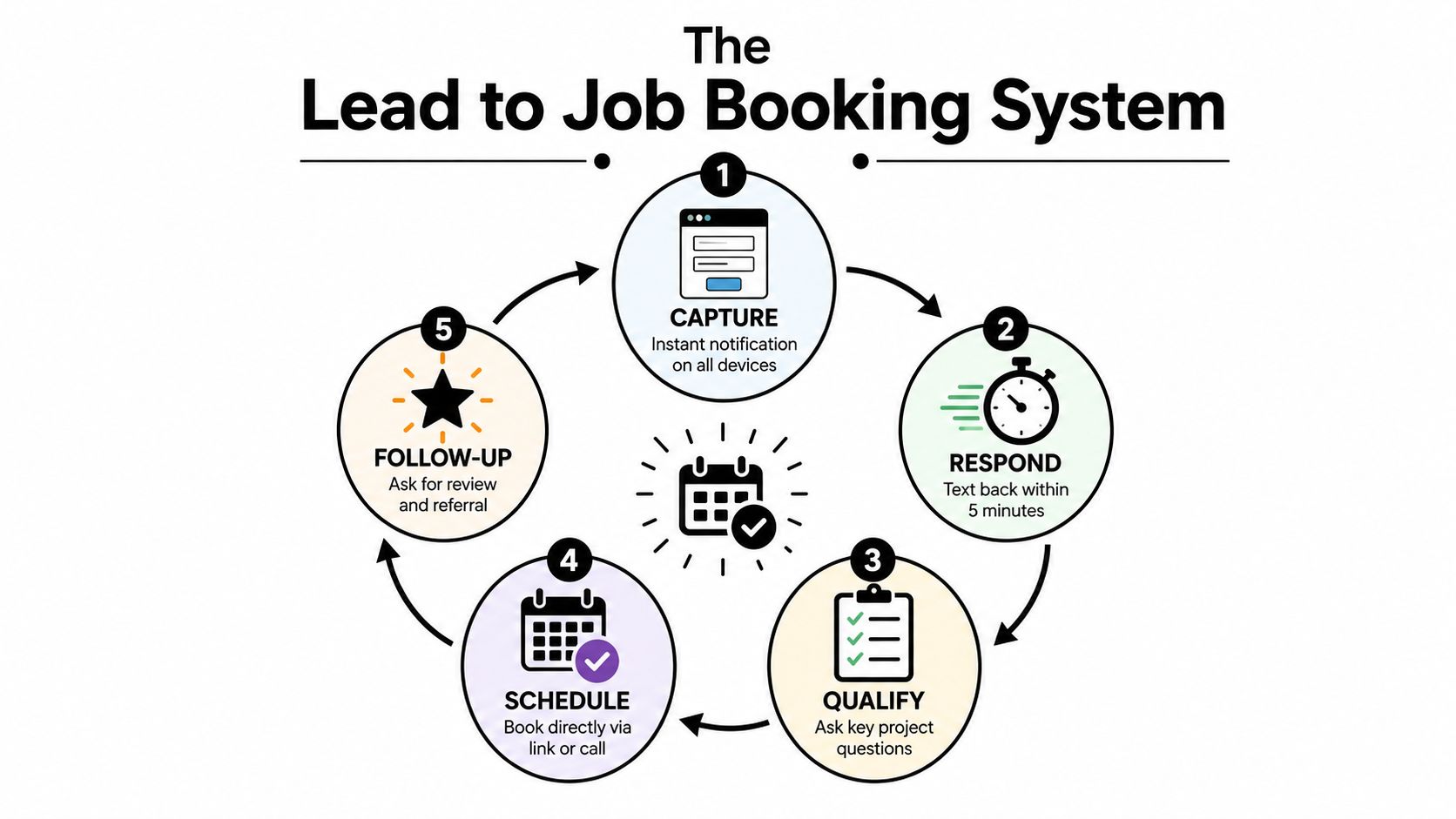
Keep the process simple enough to use on a busy day:
- Capture every inquiry in one place: calls, forms, text messages, and social DMs
- Reply fast: even a short acknowledgment keeps the lead from calling the next electrician
- Qualify in two or three questions: location, type of job, urgency
- Offer the next step immediately: booking, site visit, or photo request
- Close out after the job: review request, referral ask, and future follow-up tag
I have seen plenty of shops spend hard on lead generation and lose jobs because nobody owned the first reply. A missed-call text-back and a tight intake script usually outperform fancy automation that nobody monitors.
Treat high-intent leads differently
Lead source should change the response path.
An LSA call or a service-page form fill usually deserves immediate human contact because that customer is already shopping for a contractor. A message that starts from Instagram or TikTok may still book, but it often needs one more step of education or scheduling follow-up. Shops that lump every inquiry into the same queue usually waste good demand.
A practical rule works well here. Call high-intent leads first. Put lower-intent inquiries into a same-day follow-up sequence with clear reminders.
Use short scripts that move the job forward
Long scripts slow the office down and sound forced. Short scripts book more work because they get to the point.
Examples:
- Missed call text: “Sorry we missed your call. What kind of electrical issue are you dealing with, and what suburb are you in?”
- Website form reply: “Thanks for reaching out. We handle this type of work. If you have a photo, send it over and we'll advise the next step.”
- Estimate follow-up: “Just checking on the quote we sent. Let us know if you want to get it scheduled or if you have any questions.”
That style matches how people buy home services. They want clarity, a time slot, and confidence that you know what comes next.
Referrals work better with a system
Good electricians get referrals. Smart operators make them repeatable.
The strongest referral partners are usually adjacent trades and property-side contacts who already see electrical work coming before the homeowner calls around.
| Referral Partner | Why they matter |
| Builders and remodelers | Repeat project work and upgrade jobs |
| Letting agents and property managers | Ongoing maintenance and urgent callouts |
| Smart-home installers | AV, automation, and integration crossover |
| HVAC and plumbing companies | Shared homeowner relationships |
Be specific about what you want referred. “Send us EV charger installs, fault finding, panel upgrades, and urgent residential callouts” works better than “keep us in mind.” Then back it up by replying fast and communicating well, because referral partners remember who made them look good.
Finish every job with the same closeout routine
The best time to ask for the next action is right after good work has been delivered.
Use a standard closeout checklist:
- Confirm what was completed.
- Send the invoice and any notes or photos.
- Ask for the review while the job is still fresh.
- Mention referrals in a natural way.
- Tag the customer for future follow-up.
That last step is where a lot of value sits. Past customers already trust you. They are the first people to contact for switchboard upgrades, added outlets, exterior lighting, safety checks, and EV charger work.
This is also where the Trendy workflow connects back to operations. Profile Audit gets the first impression right. Trends & Ideas helps you publish content that attracts the right jobs. Content Creation builds trust before the call. Performance Analysis shows which channels bring inquiries that book. That full chain matters more than raw lead volume.
Measure What Matters and Execute Your 90 Day Action Plan
A busy phone does not always mean healthy marketing. For electricians, the win is booked work at the right margin, not raw lead count.
That changes what gets measured.
If local SEO brings form fills that never answer the phone, LSAs bring price shoppers, and Reels bring homeowners who already trust your work, those channels are not equal. Treating them as equal is how shops waste three months and call it marketing.
Track the numbers that change decisions
Keep the scorecard short and tied to booked jobs:
- Inbound calls by source
- Booked jobs by source
- Cost per lead
- Cost per booked job
- Close rate by channel
- Review growth
- Content that led to inquiries
- Response time to new leads
A simple scorecard works better than a bloated report no one reads. This guide to KPIs for social media that separate vanity metrics from booking signals is a useful reference if the team is still reporting on views and reach without tying them to inquiries.
The main question each week is simple. Which source brought work that got scheduled?
Review weekly, then adjust fast
Monthly reporting is too slow for local service businesses. By the time a full month passes, a weak ad group, poor call handling, or the wrong content topic has already burned budget.
Use a weekly review rhythm:
- Monday: Check missed calls, unsold estimates, and jobs completed without a review request.
- Wednesday: Review lead quality by source and listen to a sample of calls if you can.
- Friday: Log which posts, pages, or ads led to messages, calls, and booked estimates.
Tag leads by job type as they come in. EV chargers, emergency fault finding, panel upgrades, lighting, smart-home work. After a few weeks, patterns show up fast. You can see which Google Business Profile categories, LSA job types, website pages, and short-form videos are bringing profitable jobs, and which ones are just creating noise.
That is the connection across the Trendy workflow. Profile Audit improves first impressions. Trends & Ideas helps pick topics homeowners already care about. Content Creation turns field proof into trust. Performance Analysis shows which topics and channels lead to booked work, not just attention.
A practical 90 day plan
Ninety days is enough time to fix weak spots and spot real winners. It is not enough time to chase every channel.
Days 1 to 30
Get the tracking and foundation right first.
- Audit your Google Business Profile, service areas, categories, and photos
- Check that every lead source can be tracked clearly
- Clean up slow or weak website pages for priority services
- Set a review request process that happens after every completed job
- Tighten missed-call handling, text-back speed, and estimate follow-up
- Review current content and keep only the topics tied to real inquiries
Days 31 to 60
Put measured volume into the system.
- Refine LSAs based on booked jobs, not just lead count
- Build or tighten search campaigns around high-value services
- Publish short field videos that answer the questions customers ask before booking
- Track which topics create calls, not just comments or views
- Train whoever answers the phone to confirm urgency, location, and job type quickly
Days 61 to 90
Shift budget and effort toward what books.
- Compare booked-job rate by source
- Cut weak keywords, poor service areas, or low-intent offers
- Increase spend on channels that produce profitable work
- Use winning jobs as new review prompts, service-page proof, and video topics
- Rework follow-up for estimates that should have closed but did not
A lot of electrician marketing either sharpens up or stalls out. Shops that review channel quality every week usually find one uncomfortable truth. The channel getting the most leads is often not the channel getting the best jobs.
The practical takeaway
Run the next 90 days around booking rate and trust conversion.
Get found through local search. Show proof through reviews, photos, and short-form video. Answer fast. Follow up until the estimate gets a yes or a no. Then keep feeding the channels that bring work your team wants more of.