How to Get Twitter Verified in 2026: A Complete Guide
What if the blue check isn't proof that you're credible, but proof that you've paid and stayed clean enough to keep it? That's the part many users still miss when they ask how to get Twitter verified in 2026. The badge is no longer a fame trophy, it's a paid access signal on X, and if your profile looks messy, dormant, or suspicious, that badge can become a liability fast.
The New Reality of X Verification in 2026
What does the blue check mean now? On X, it is tied to X Premium or Premium+, and X's own Premium documentation confirms that badge recipients are no longer reviewed under the former "active, notable, and authentic" standard (X Premium help).
That changes the job. You are not chasing editorial approval or old-school fame markers. You are paying for access, then making sure the account still looks real, active, and worth trusting.
Treat verification as a profile health problem. If your public profile is weak, the badge can create more scrutiny than credibility. If you are deciding whether that effort is worth it, the guide to social ROI for startups is a useful way to weigh the business case instead of obsessing over the icon.
The people who handle this best keep the account clean before they buy the plan. They use a profile that matches the brand or creator, and they build visible activity that makes the account look maintained, not abandoned. That is where how to increase followers on Twitter fits in, because follower growth and profile credibility should move together. A verified account with no audience momentum still looks thin.
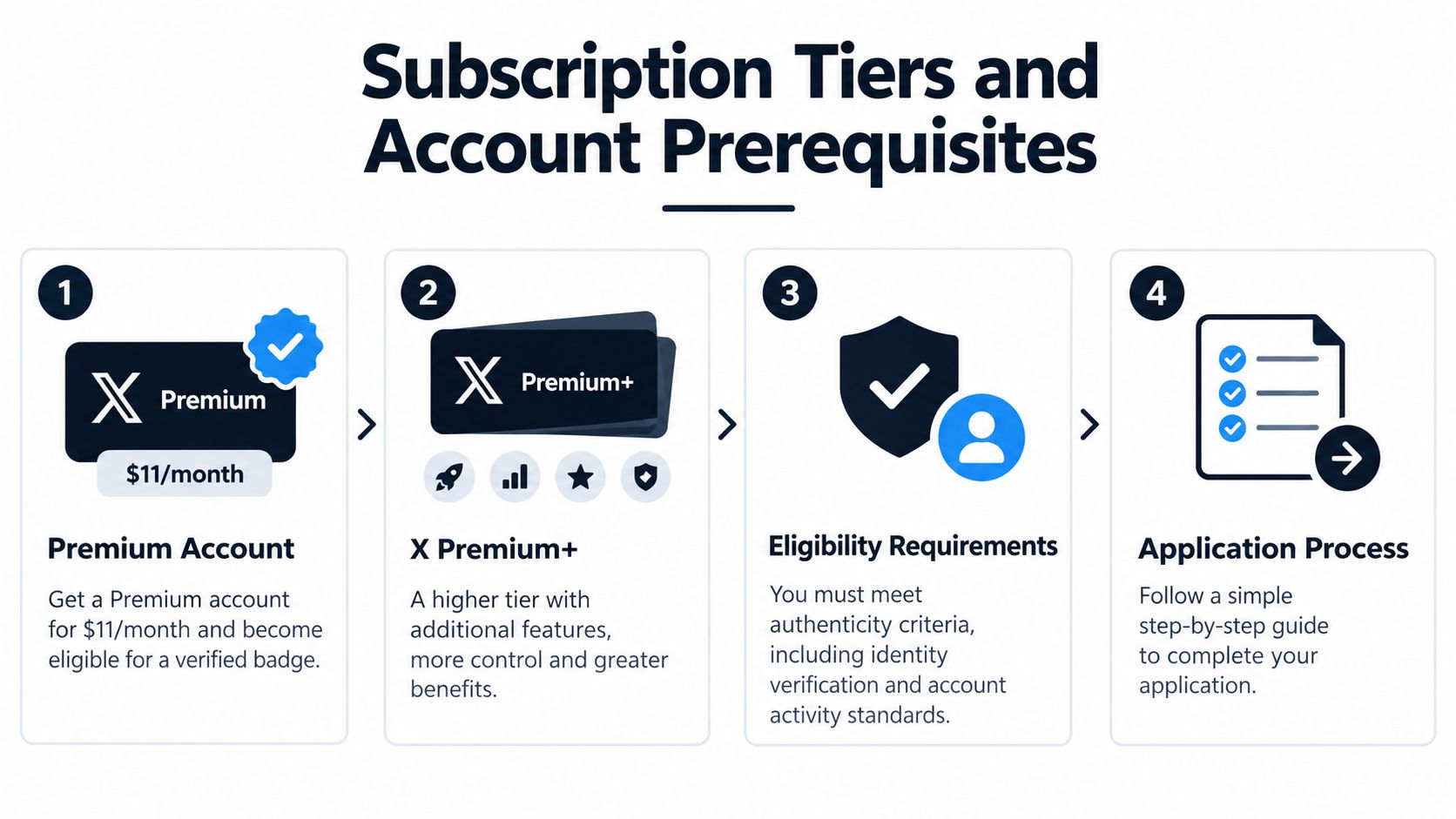
Subscription Tiers and Account Prerequisites
Paying for the badge does not make the account ready for it.
X's Premium eligibility rules still require a display name, a profile photo, a confirmed phone number, and recent account activity. If any of those pieces are missing, rejection or later removal is the predictable result. Build the account first, then buy the plan.
The checklist that actually matters
Start with the public profile. Use a name people expect to find, a real photo or clean logo, and a confirmed phone number before you spend money. That gives the account the basic shape of something maintained, not something thrown together at the last minute.
Activity matters just as much. If the account has gone quiet, the badge looks out of place and invites scrutiny. Keep the profile active enough that it looks owned and tended, not parked.
Practical rule: buy the plan only after the account looks alive, complete, and boring in the best way possible.
Why sudden profile changes hurt you
Changing your display name, profile photo, or username can trigger a temporary loss of the checkmark while X reviews the account for impersonation risk. That is normal platform behavior, not a glitch to chase.
Keep the account stable once it is set. If you keep renaming it or swapping visuals, you create the exact kind of inconsistency that slows review and makes the badge look less credible. Per the Premium eligibility rules cited above, the platform wants an account that is reachable, current, and clearly tied to one operator.
For a practical cross-check, the discipline mirrors the YouTube Partner Program application, where check your 2026 eligibility steps before monetization is ever granted. The point is simple. Clean the house before you ask for the reward.
If you want the account to stay active without scrambling every day, how to schedule posts on X helps you keep a steady posting rhythm. That consistency keeps the badge attached to a profile that still looks lived in.
Building a Public Profile That Passes Review
Can a blue check survive a weak profile? Sometimes, but it usually looks sloppy and invites the wrong kind of attention. X may grant the badge, yet people still judge the account in seconds by what is on screen. A vague bio, recycled photo, and random posting pattern do not help, they make the badge look like decoration.
Make the profile read like a real operator
Your bio should match the account's real purpose. If you are a creator, say what you make. If you are a founder, say what the business does. If you are a brand, make the category obvious without sounding like corporate copy. The goal is clarity, not cleverness.
Your visuals should back that up. Keep the same name structure and visual identity across platforms where you can, because consistency makes impersonation less likely and makes the account easier to trust at a glance. X's verification policy is built around avoiding misleading or deceptive identity behavior, so the profile has to look like it belongs to one real operator, not a bundle of borrowed signals.
Consistency beats costume changes
The best verified profiles usually look ordinary in a good way. They post often enough to feel current, they reply like humans, and they do not keep shifting persona. A brand that keeps changing its name, avatar, and tone creates friction for anyone trying to trust it.
A verified profile should answer three questions instantly, who are you, what do you do, and why should anyone believe this account is yours?
That is why content discipline matters. You do not need to post nonstop, you need a steady public record of useful posts, replies, and updates that makes the account easy to recognize and hard to fake. For the audience side of that discipline, see getting more Twitter followers, since a verified account still needs visible momentum.
For anyone building a personal brand, how to build a personal brand on Instagram is a useful companion mindset piece. The same identity discipline applies across platforms. Verification works better when the story is already coherent before the badge shows up.
Troubleshooting Rejections and Revocations
If the badge disappears after a profile edit, don't assume you've been permanently banned from verification. The most common explanation is a temporary review hold triggered by a recent change, especially to the name, photo, or username. The fix is usually boring, which is good.
First, verify the email address, confirm the phone number, and turn on two-factor authentication if it's not already active. X's rules also call out repeated policy violations and deceptive identity practices as problems, so if your account has been posting aggressively or skating near the edge of the rules, clean that up immediately (X verification policy).
Technical problem or policy problem
Treat the issue like a diagnosis. If the account is complete, secure, and active, but the badge vanished after a rebrand, you're likely dealing with review timing. If the account has sketchy behavior, low activity, or obvious impersonation risk, the badge loss is a policy signal, not a bug.
Here is the cleanest way to see it:
- Security issue: confirm email, phone, and two-factor authentication.
- Activity issue: post and engage consistently so the account looks alive.
- Identity issue: stop changing your visible identity every few days.
- Policy issue: remove misleading behavior before expecting the badge to stay.
That distinction matters because it saves you from wasting time on the wrong fix. A clean account rarely fights the system. A sloppy one keeps triggering the same review cycle.
This social media risk guide is worth reading if your team has multiple people touching the same account, because the fastest way to lose trust is through avoidable operational chaos. Verification is much easier to keep when one person owns the rules and everyone else stops freelancing.
Maintaining Your Badge with a Creator Workflow
Getting the check is easy compared with keeping the account healthy enough that the badge still feels justified. The cleanest approach is to build a repeatable workflow that keeps your profile active, your content relevant, and your public presence obviously human. If your account goes quiet, the badge starts to look cosmetic.
Run the same basic loop every week
Start with a profile audit. Check your name, photo, bio, link, and pinned post. If any of those elements drift out of sync with the way you show up online, fix them before they create confusion.
Then move into trends and ideas. Don't post random filler just to keep the account alive. Choose a few topics you can sustain, then turn those into posts, replies, threads, and short-form video ideas. Consistency is what makes the account look maintained, not volume for its own sake.
Keep the account visibly active
A verified profile should never feel dormant. That doesn't mean spamming the feed. It means you keep showing up with a recognizable point of view, whether that's through posts, quote posts, reply chains, or quick updates on what you're working on.
The content mix should stay practical. For some accounts, that means ready-to-shoot video scripts and hooks. For others, it means scene structures, carousels, visual post concepts, or clean LinkedIn posts and Threads/X posts that reinforce the same brand story. The platform changes, but the rule stays the same, don't let the profile go stale.
Use performance feedback like a grown-up
The best creators don't guess forever. They check what gets replies, what gets saves, what gets follows, and what disappears without a trace. That feedback tells you whether the account still feels relevant or whether you've wandered into posting for yourself instead of for the audience.
If you're using a tool like Trendy, this is the workflow it should support, profile audit first, then trends and ideas, then content creation, then performance analysis. That sequence matters because a badge on a weak content system is just decoration. A badge on a disciplined workflow becomes a trust amplifier.
Blue Check vs Organizational Verification
The personal blue check and organizational verification serve different jobs, so treat them as separate choices. The personal route fits an individual creator, founder, or public-facing professional. Organizational verification fits an entity that needs the account to speak for the institution itself.
That difference changes how people read the badge. A personal badge signals that the account meets paid access and identity checks. An organizational signal says the brand or institution behind the account is official, which is a different promise.
The old scarcity still explains the confusion. In November 2022, Twitter had more than 420,000 verified accounts, which was less than 0.2% of approximately 240 million daily active users. That meant fewer than 2 verified accounts for every 1,000 daily active users (Mashable's report on the verification pause). Verification used to look like a status prize. Now it works more like a managed access layer.
Verification types compared
| Feature | Personal Premium | Organizational |
| Who it fits | Individual creators, founders, and public personalities | Businesses, institutions, and official entities |
| Main signal | Paid subscription plus account eligibility review | Official representation of the organization |
| Profile focus | Complete personal or creator profile | Clear brand identity and institutional consistency |
| Risk if misused | Impersonation or policy friction | Confusion over who the account officially represents |
If your business presence depends on a public face, building a personal brand on Instagram helps because the same rule applies across platforms, trust starts before the badge. The right badge only works on top of a clear account identity.
Choose organizational verification when the account speaks for the company. Keep the personal badge when you, the individual, are the brand.