
You post consistently, tweak your hashtags, follow trending sounds, and still watch your TikTok views stall. So, how do you get your views up on TikTok? Fix topic clarity, the opening hook, watch-time retention, shareability, and posting timing as one system. Random uploads may get lucky, but a repeatable process gives every post a better chance to be understood, watched, searched, saved, and shared.
TikTok had at least 1.59 billion users worldwide in January 2025, according to DataReportal's TikTok statistics. That audience creates enormous opportunity, but it also means vague content gets buried quickly. Your workflow should move from Profile Audit to Trends & Ideas, then Content Creation, and finally Performance Analysis.
Why Your TikTok Views Feel Stuck Right Now
The frustrating pattern is familiar. You publish a useful video, wait for distribution, see a modest burst of views, and then nothing. The problem usually isn't that TikTok has decided your account is invisible. More often, the platform receives mixed signals about who should watch your content, why they should stay, and whether the video deserves another round of distribution.
Your first job is to stop treating views as a single outcome. View growth depends on several connected questions:
- Does the topic make sense immediately? A viewer should understand the subject before deciding whether to keep watching.
- Does the first moment create tension or curiosity? A slow greeting wastes the most valuable part of the video.
- Does the structure reward attention? Viewers need a reason to continue, not just a reason to start.
- Does the post arrive at a useful time? A strong video can lose early momentum when it reaches the wrong audience window.
TikTok discovery also behaves like a hybrid of a feed and a search environment. People watch, search for related topics, revisit useful videos, and share posts with friends. That makes searchable, saveable, and rewatchable content more durable than content built only around a fleeting visual trend. Independent coverage of the 2025 TikTok trend landscape highlights this shift toward clearer topics and higher-intent engagement.
Practical rule: Don't ask only, “How can I get more views?” Ask, “What would make the right viewer watch this twice, save it, or search for it later?”
A useful account review starts with your profile positioning, then moves into trend and idea selection. After that, create a specific format with a strong hook, publish it in a tested window, and study the result. TikTok's distribution mechanics are easier to apply once you understand how the TikTok algorithm works, but the principle is simple: make the content easy to classify and hard to abandon.
Your account needs a feedback loop, not a superstition. If the topic is unclear, fix the framing before changing your editing app. If viewers leave immediately, rewrite the hook before buying better equipment. If people watch but don't search, save, or share, strengthen the usefulness or emotional payoff.
Diagnose What Is Holding Your Reach Back
Before you create another video, inspect the evidence already sitting in your analytics. A low-view post can fail because of a weak opening, an unclear promise, a mismatch between topic and audience, or a format that runs longer than the idea deserves. Those problems require different fixes, so copying another creator's posting routine won't help until you know which one is yours.
Start with the retention curve. Look for the earliest meaningful drop, then compare it with the moment where the video explains its value. If viewers leave before the main point, the opening needs work. If they stay through the hook but disappear during the explanation, the structure or pacing is the problem.
Read the signals in the right order
Average watch time tells you whether the video holds attention in practical terms. Completion rate shows whether viewers reach the ending, while rewatches suggest that the video contains a useful detail, satisfying reveal, or loopable structure. Saves and shares often reveal stronger intent than a passive view, because the viewer has decided the content is worth returning to or passing along.
Traffic source adds context. A post with For You distribution but weak search discovery may need clearer spoken keywords, on-screen wording, or caption framing. A post that earns search attention but poor retention probably answers the right question too slowly.
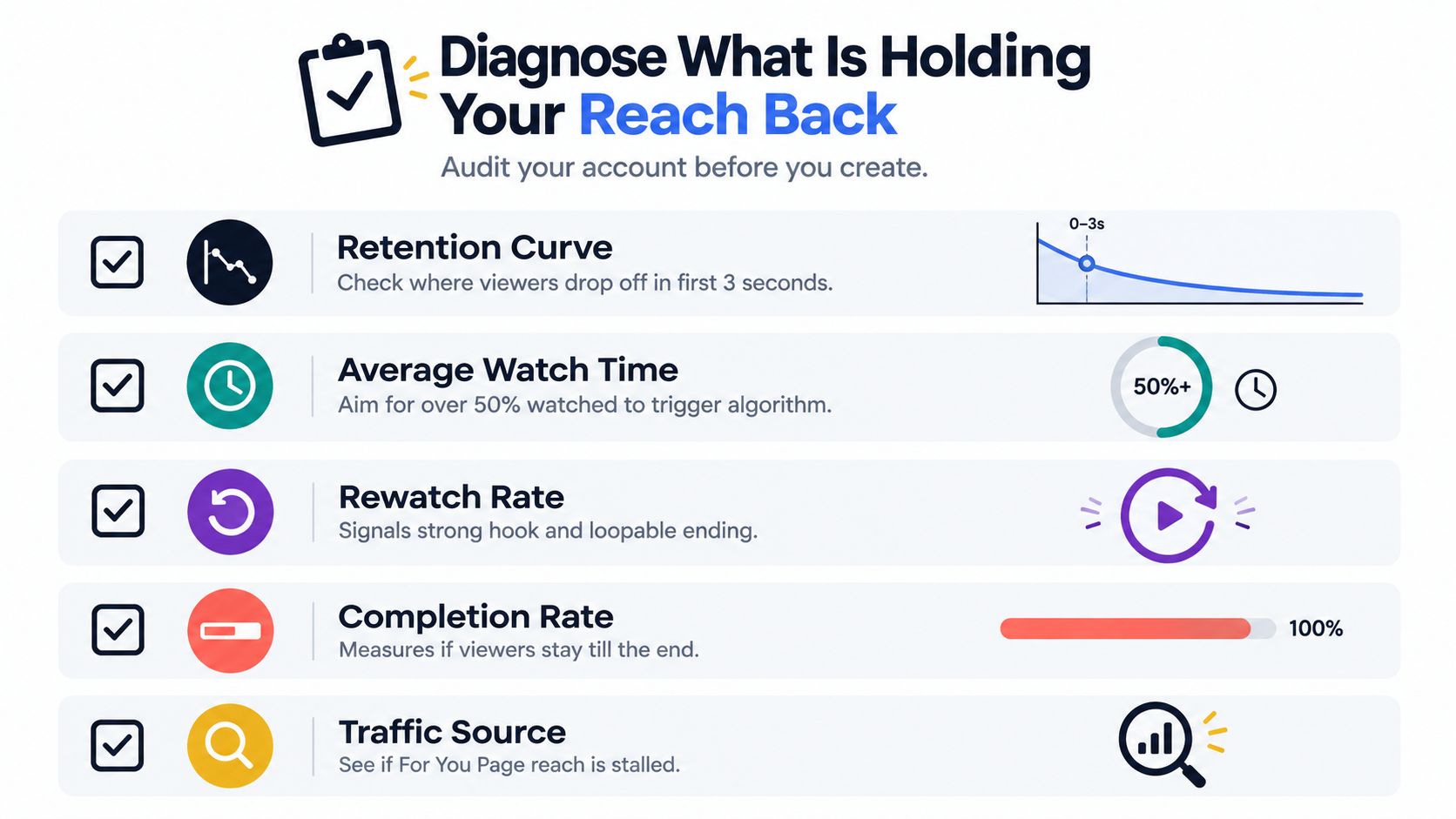
Run this quick audit across your recent posts:
- Opening: Does the first spoken line identify a problem, outcome, or surprising claim?
- Topic: Could a new viewer describe the video's subject without checking your profile?
- Retention: Where do viewers leave, and what happens immediately before that moment?
- Intent: Are viewers saving, sharing, commenting with questions, or scrolling away?
- Discovery: Does the caption and on-screen text use the language your audience would search?
Don't turn every metric into a target. The purpose of the audit is prioritization. If several posts lose viewers at the opening, write five stronger hooks before changing your hashtag set. If retention holds but reach stays narrow, improve topic classification and trend fit.
Start with a profile-level diagnosis
A profile audit should examine your niche, audience, recent content patterns, and performance signals together. Trendy's Profile Audit can be used at this stage to surface personalized areas to improve before you spend time scripting new videos. You can also use this TikTok profile audit guide to check whether your bio, visual identity, pinned posts, and content themes support the same audience promise.
End the audit with one prioritized decision. Choose the bottleneck that appears most often, then build the next batch around fixing it. More content won't solve a recurring opening problem, and better hooks won't solve an account that keeps switching topics without a clear niche core.
Hooks and Formats That Earn More Watch Time
Most view problems become visible in the first few seconds. Your opening doesn't need to be loud, exaggerated, or misleading. It needs to give the viewer a clear reason to stay.
Use one of these hook patterns as a starting point:
- The problem hook: “Your TikTok views may be stuck because your first sentence explains too much.”
- The outcome hook: “Use this three-part structure to turn a vague idea into a ready-to-shoot video.”
- The contradiction hook: “Posting more won't automatically fix low TikTok views. Your retention signal comes first.”
Each hook works because it names a tension. The viewer recognizes a problem, wants the promised outcome, or feels compelled to resolve the contradiction. Avoid opening with your name, a long greeting, or background information that can wait until later.
Match the format to the promise
A tutorial needs a visible sequence. Show the result, name the steps, and demonstrate the first useful action before adding context. A trend-based video needs a recognizable format, but your niche angle should appear immediately so the trend doesn't attract the wrong audience. A story needs a question or unresolved moment that makes the ending matter.
Use these structures:
- Tutorial: Result first, three actions, common mistake, concise recap.
- Trend adaptation: Familiar sound or format, niche-specific text, one original insight.
- Story: Strongest moment, brief setup, complication, payoff.
- Comment response: Display the question, answer directly, add one example, invite a related question.
Trendy can generate ready-to-shoot TikTok scripts, scene structures, hooks, and editing directions from a creator's niche. A script should tell you what to say, what appears on screen, and when the scene changes. That makes filming easier than staring at a blank notes app with a vague idea like “make a helpful video.”
For more examples, use this guide on how to write hooks. Keep the language natural, though. A formula is useful only when it sounds like something you would say.
TikTok's length mechanics also affect your production workflow. TikTok's Help Center states that videos recorded inside the app can be up to 10 minutes, while uploaded videos can be up to 60 minutes. TikTok documentation and third-party coverage also show that access can vary, with all creators able to post 3-minute videos, some accounts able to post 5-minute or 10-minute videos, and uploaded videos documented at up to 60 minutes in supported workflows, as outlined by SocialRails' TikTok video length guide.
That doesn't mean longer is better. Use a short clip for a fast answer or visual reveal. Use a longer upload when the explanation, tutorial, or story needs room. Instagram now allows Reels up to 3 minutes, following its January 2025 expansion, according to Social Media Today's coverage of the Reels update. For repurposing, cut one core idea into platform-specific versions instead of uploading the same edit everywhere.
Quick cuts, captions, close framing, and pattern interrupts should support comprehension. Change the visual when the thought changes, not because an editing template tells you to. Clear audio and readable text matter more than decorative effects.
Ride Trends Without Losing Your Niche
A trend is useful only when it carries your subject to the right people. If you copy a popular sound without adding a recognizable niche angle, you may attract viewers who have no reason to follow, save, or watch your next post.
Start with your niche core. Write down the problem you solve, the audience you serve, and the point of view that makes your content yours. Then filter every trend through that core before you film.
Use this four-part filter:
- Relevance: Can you connect the trend to a question your audience already asks?
- Adaptation: Can you change the example, wording, or payoff instead of copying the original?
- Searchability: Will the spoken words and on-screen text tell TikTok what the video is about?
- Timing: Is the trend still giving creators room to add a fresh angle?
A cooking creator can adapt a reaction format to explain a common recipe mistake. A fitness creator can use a sound to contrast an ineffective routine with a more practical one. A small business owner can turn a trending structure into a behind-the-scenes explanation of pricing, packaging, or customer questions.
Use trend data as a starting point
Trend discovery should combine platform observation with category relevance. Browse real-time TikTok trend data to see emerging sounds and formats, then ask whether the trend gives your audience a useful reason to stop. Trendy's Trends & Ideas workflow can help connect emerging sounds, hashtags, and video formats to your niche rather than presenting a generic list of popular concepts.
Hashtags should classify the post, not carry the entire reach strategy. Choose tags that describe the topic, audience, or format, and pair them with precise language in the script and caption. A hashtag cannot rescue a video that doesn't make its subject clear.
Your editing workflow should preserve the trend's recognizable structure while adding your own voice. Tools such as CapCut, InShot, or TikTok's native editor can handle cuts, captions, and timing, but the creative decision comes first. Don't spend an hour matching transitions when the opening line still sounds generic.
Trend forecasting for social media becomes useful when it helps you act early and selectively. Keep a running idea bank with the trend, your niche adaptation, the searchable phrase, and the intended viewer action. That turns trend discovery into a repeatable content workflow instead of an endless scroll through sounds.
Posting Rhythm and Timing That Actually Lifts Views
Consistency works best when you treat it as a controlled experiment. A large analysis of 11.4 million TikTok posts from more than 150,000 accounts found that posting 2 to 5 times per week produced a 17% lift in views per post compared with posting once weekly. The same analysis found a 29% lift at 6 to 10 posts per week and a 34% lift at 11 or more posts per week, with diminishing returns as volume rises, as reported by Search Engine Journal's TikTok posting study.
| Posts Per Week | Lift vs 1 Post Per Week | What It Means For You |
| 1 | Baseline | Too little testing data for a reliable rhythm |
| 2 to 5 | 17% | The most practical starting range for consistent batches |
| 6 to 10 | 29% | More testing capacity, but higher production pressure |
| 11+ | 34% | More output with diminishing returns and fatigue risk |
The jump from one post to a sustainable batch matters more than blindly doubling production. The same analysis found that moving from 5 to 10 weekly posts added only 12 percentage points to the per-post lift, so measure views per post rather than celebrating volume alone.
Run a timing test
Benchmark coverage points to weekday afternoons and early evenings in the audience's local time as sensible starting windows. One benchmark analysis reported an average TikTok engagement rate of 3.70% in 2025, up 49% year over year, based on 70 million posts, with average views per post of 6,496, according to IQFluence's TikTok timing research. Treat those figures as market context, not a promise for your account.
Test two daily windows in your audience's local timezone. Compare each post's 7-day view curve, early engagement velocity, watch time, and shares. Keep the windows that consistently create the strongest initial response, then revisit the test when your audience or niche changes. A single global posting time ignores where your viewers live and can weaken the early signal that supports wider distribution.
A practical weekly workflow looks like this:
- Planning day: Choose one educational idea, one trend adaptation, and one audience-question response.
- Batch filming day: Record the videos together while your lighting, framing, and setup are ready.
- Editing block: Create captions, covers, and platform-specific cuts.
- Publishing days: Release the batch in tested local-time windows.
- Review day: Compare view curves and decide what to repeat, revise, or drop.
Use social media consistency tips from Kraken Socials to make the routine manageable across platforms. Trendy's planning workflow can also coordinate TikTok with Instagram Stories and posts, content calendars, and scheduled publishing decisions, so consistency doesn't require rebuilding your week from scratch. For timing ideas specific to your account, review the best time to post on TikTok today.
Turn Views Into Momentum With Trendy
A post can spike overnight, then stall because you never identified the reason viewers stayed. Check the topic, opening line, format, edit, sound, length, timing, saves, and rewatches. That answer turns the next upload from a guess into a controlled test.
Trendy connects that test through Performance Analysis. Start with a Profile Audit to clarify your niche, audience, and current bottleneck. Then use Trends & Ideas to find sounds, hashtags, and formats that fit your subject. Build the concept with Content Creation, including hooks, ready-to-shoot scripts, scene structures, and captions. After publishing, Performance Analysis shows which elements earned attention and what to change next.
Use the loop every time:
- Profile Audit: Identify the reach problem.
- Trends & Ideas: Select a relevant, searchable angle.
- Content Creation: Shape a hook and format people can watch, save, or replay.
- Performance Analysis: Measure the response and carry the winning lesson into the next post.
The market is crowded, so “post more” is a weak plan without stronger iteration. Recent benchmark coverage found that 73% of views came from the For You tab, while 96% of views and 98% of interactions occurred within the first 10 days. It also reported that average views per post fell 31% in early 2026 as content volume rose nearly 80%, as documented by Metricool's TikTok trends report. Treat those figures as context, then improve your own hook, format, timing, and repeatable process.
Trendy supports more than TikTok captions. Its cross-format social media co-pilot covers TikTok, Instagram, LinkedIn, and Threads/X, with video scripts, hooks, carousels, visual post concepts, and platform-specific posts. Use the TikTok content calendar template to turn proven topics into a clear publishing queue.
Creators who want an AI content creation app can use the web app with their existing editing tools, or download Trendy for iOS and Android. Connect your account, run the profile audit, publish one focused batch, and study the result. View growth comes from searchable ideas, saveable formats, rewatchable hooks, and disciplined iteration.
Start with Trendy's profile audit and performance analysis tools, then turn each result into a sharper next post.